Turning a seasonal tomato harvest into smooth sauce, salsa, or puree is much easier with the right press. These tools separate skins and seeds while reducing the time and mess involved in processing large batches.
Our roundup includes manual models for occasional home use and electric machines for gardeners, cooks, and small-scale producers processing tomatoes by the bucketful. Use the guide below to match capacity, power, cleanup, and budget to your harvest routine.
Best 10 Tomato Presses for Seasonal Harvests Picks for 2026
Best Electric Batch Press
Weston Deluxe Electric Tomato Strainer

- 250-watt motor with forward and reverse speeds
- One-gallon hopper for larger preserving batches
- Three stainless steel screens included
Best For: Large seasonal harvests and batch preserving
Best Traditional Sauce Maker
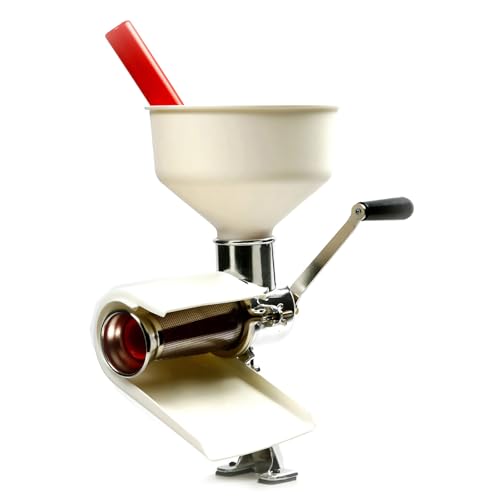
- 3-quart or 95-ounce capacity
- Chrome-plated screen separates juice and pulp
- Fine mesh screen and recipe booklet included
Best For: Home sauce, fruit, and vegetable preparations
Best Compact Suction-Mount Press

- Juices tomatoes without peeling, deseeding, or coring
- Suction-cup base helps stabilize the mill
- Stainless steel pusher included
Best For: Small-batch sauces, purees, and salsa
Best Simple Manual Press
Durable PP and Stainless Steel Tomato Press

- PP body with stainless steel filter
- Large feed inlet for faster loading
- Separates peel and seeds from pulp
Best For: Manual sauce, juice, and vegetable straining
Most Versatile
Johnny Model 250 Electric Food Strainer

- Manual crank or included electric motor
- Multiple screens for sauces, jams, and purees
- 5-year warranty with sturdy clamp mount
Best For: Home preservers processing varied fruits and vegetables
Best Manual Value
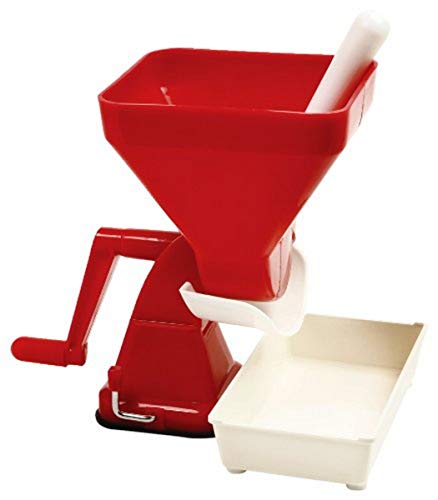
- Large 2.25-quart hopper for batch work
- Stainless mesh removes skins and seeds
- Suction base stabilizes manual cranking
Best For: Manual tomato and applesauce preparation
Best for Large Batches

- 450W motor rated for 200–350 lb/h
- 304 stainless steel food-contact parts
- Wide feed chute and tool-free cleanup
Best For: High-volume harvest processing and canning prep
High-Capacity Pick
COSTWAY 450W Electric Tomato Strainer
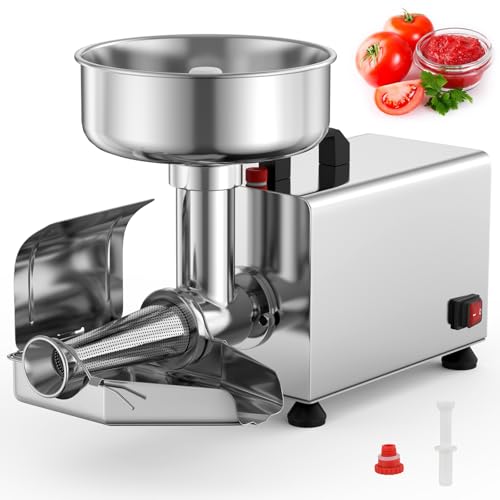
- Claims 200–350 lb/h processing
- 304 stainless-steel food-contact parts
- Tool-free, dishwasher-safe detachable parts
Best For: Large seasonal harvests and high-volume sauce making
Commercial-Style Value
Newhai 450W Electric Tomato Strainer

- 450W motor with 8.4-inch funnel
- Claims up to 110 lb/h output
- Processes tomatoes and several fruits
Best For: Moderate harvest batches and small commercial kitchens
Quiet Operation Pick
VBENLEM 370W Electric Tomato Strainer
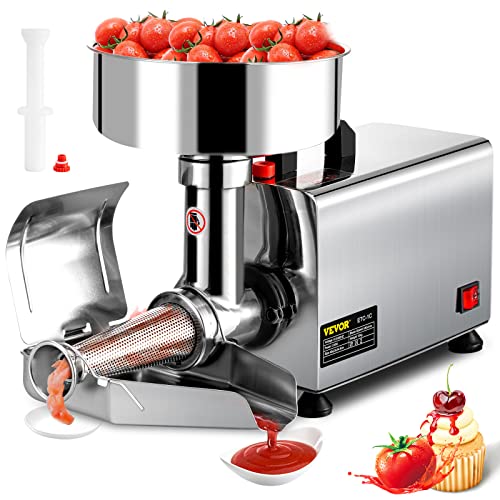
- 9-inch fruit-feeding funnel
- Adjustable trough helps direct sauce
- 304 stainless-steel food-contact parts
Best For: Small-batch preserving with quieter operation and controlled discharge
Best Electric Batch Press – Weston Deluxe Electric Tomato Strainer
For seasonal harvests, the Weston Deluxe Electric Tomato Strainer is built to process larger quantities with less manual effort. Its 250-watt motor, two-speed operation, one-gallon hopper, and interchangeable screens make it a versatile option for sauces, purees, jellies, and salsa.
Best For: Gardeners and home preservers processing large batches of tomatoes or other soft produce.
Pros:
- Electric 250-watt motor with forward and reverse speeds to help prevent jamming.
- One-gallon hopper supports larger batches without frequent refilling.
- Includes 1.5mm, 3mm, and 6mm stainless steel screens for fine to chunky results.
- Removes skins and separates seeds without requiring coring.
Cons:
- Requires access to a 120-volt AC power source.
- Its 14-by-12-by-17-inch size may require dedicated storage space.
The Weston is the most harvest-focused choice here, combining electric convenience with a generous hopper and multiple screen sizes. It makes particular sense when seasonal preserving involves repeated or sizable batches.
Best Traditional Sauce Maker – Norpro 1951 Sauce Master
The Norpro 1951 Sauce Master is a straightforward option among tomato presses for seasonal harvests, using a chrome-plated steel screen to separate juice and pulp in one operation. Its 3-quart capacity suits home cooks making sauces, fruit preparations, and vegetable purees.
Best For: Home cooks who want a multi-use strainer with a standard fine mesh setup.
Pros:
- 3-quart, 95-ounce capacity for home-sized batches.
- Automatically separates juice and pulp through a chrome-plated steel screen.
- Includes a standard fine mesh screen, standard spiral, recipe, and instruction booklet.
- Additional berry, pumpkin, and salsa screens are available separately.
Cons:
- Additional specialty screens are not included.
- The supplied notes do not specify an electric motor or powered operation.
With its included fine mesh screen and useful 3-quart capacity, the Sauce Master is a practical middle ground for routine home preserving. Consider it if you want one core strainer and may add specialty screens later.
Best Compact Suction-Mount Press – Tomato Strainer Food Mill
This compact tomato strainer is a convenient choice for smaller seasonal harvests and everyday kitchen use. It juices and purees tomatoes without peeling, deseeding, or coring, while its suction mount helps hold the food mill in place during use.
Best For: Home cooks who prioritize a compact manual press for salsa, sauces, and tomato purees.
Pros:
- Separates skins and seeds while directing juice into the tray.
- Suction-cup base helps secure the food mill during operation.
- Includes a stainless steel pusher for guiding tomatoes into the press.
- Suitable for straining, juicing, pureeing, and homemade salsa.
Cons:
- Manual operation requires hands-on effort.
- The 9-by-6-by-8-inch design is better suited to smaller batches than bulk processing.
- Its plastic construction may feel less substantial than stainless-steel-heavy alternatives.
This press favors simplicity and a small footprint over high-volume throughput. It is a sensible fit for cooks who want fresh tomato preparations without the extra steps of peeling, deseeding, or coring.
Best Simple Manual Press – Durable PP and Stainless Steel Tomato Press
For shoppers comparing tomato presses for seasonal harvests, this manual model offers a simple, durable construction with PP material and a stainless steel filter. Its large feed inlet is designed to accept more produce at once while separating peel and seeds from the pulp.
Best For: Home cooks seeking a straightforward manual tool for tomato sauce, fruit juice, or strained vegetables.
Pros:
- Combines durable PP construction with a stainless steel filter.
- Designed to separate peels and seeds for a smoother pulp consistency.
- Large-capacity feed inlet can help speed up preparation.
- Simple structure is intended to be easy to clean and assemble.
Cons:
- Manual pressing requires physical effort.
- The supplied notes do not specify the exact capacity or dimensions.
- No extra screens or accessories are listed as included.
This press keeps the feature set focused on durability, yield, and uncomplicated operation. It is worth considering when you want a versatile manual press and do not need electric assistance or multiple screen options.
Most Versatile – Johnny Model 250 Electric Food Strainer
For tomato presses for seasonal harvests, the Johnny Model 250 stands out as a flexible option for cooks who want both manual and powered processing. Its interchangeable screens handle tomato sauce, salsa, purees, juices, jams, and more while separating skins and seeds.
Best For: Home preservers who want one strainer for tomatoes, fruits, vegetables, and specialty sauces.
Pros:
- Includes tomato, berry, pumpkin, salsa, and grape screens.
- Works with the hand crank or included electric motor.
- Strong clamp mounts to countertops 3/4 to 2-1/8 inches thick.
- Includes a 5-year warranty and BPA-free plastic components.
Cons:
- Clamp mounting requires a compatible countertop edge.
- Its 8-pound body and multiple accessories may take more storage space.
The Model 250 is a strong all-purpose choice when seasonal tomato processing is only one part of your food-preserving routine. Its screen selection provides more flexibility than a tomato-only press.
Best Manual Value – Norpro Jumbo Tomato Strainer
The Norpro Jumbo Tomato Strainer is a straightforward manual pick among tomato presses for seasonal harvests. Its stainless steel mesh separates seeds, skins, and stems as you crank fresh tomatoes into sauce, salsa, juice, puree, or paste.
Best For: Home canners who prefer manual processing and need a larger hopper for batch preparation.
Pros:
- Large 2.25-quart hopper supports bigger produce batches.
- Stainless steel mesh automatically separates skins, seeds, and stems.
- Suction base helps secure the press on smooth countertops.
- Includes a receiving tray, pestle, instructions, and starter recipes.
Cons:
- Manual cranking requires more hands-on effort than an electric model.
- The suction base is intended for smooth surfaces.
Choose the Norpro when you want a dedicated, easy-to-understand press for tomato and apple processing without adding a motor. Its hopper and tray are practical for routine canning preparation.
Best for Large Batches – 450W Electric Tomato Strainer
For large tomato harvests, this 450W electric strainer is designed to reduce manual work and maintain a steady processing pace. Its 304 stainless steel food-contact parts and wide feed chute suit tomato sauce, juice, jam, and canning preparation.
Best For: Home canners, small businesses, and other users processing substantial quantities during harvest season.
Pros:
- 450W pure copper motor is rated for 200–350 pounds per hour.
- 304 stainless steel food-contact components resist corrosion.
- Wide 8.5-inch feed chute supports continuous feeding.
- Tool-free assembly and dishwasher-safe detachable parts simplify cleanup.
Cons:
- At 20.9 pounds, it is substantially heavier than manual options.
- Its electric operation requires access to a 110V power source.
- The higher-capacity design may be more machine than occasional users need.
This model makes the most sense when harvest volume and processing speed matter more than compact storage or manual simplicity. Anti-slip feet, an enclosed motor guard, and a waterproof switch add practical operating features.
High-Capacity Pick – COSTWAY 450W Electric Tomato Strainer
For large seasonal harvests, the COSTWAY electric tomato strainer is built around a 450W full-copper motor, a large feed chute, and a claimed processing rate of 200–350 pounds per hour. Its stainless-steel construction and tool-free disassembly make it a practical option when you need to process substantial batches of sauce or fruit preserves.
Best For: Large home harvests, farm stands, and users who want high-volume tomato processing.
Pros:
- Claims a high processing range of 200–350 pounds per hour.
- Food-contact components use 304 stainless steel.
- Detachable parts are dishwasher-safe, according to the supplied notes.
- Includes safety features such as an enclosed motor guard, insulated switch, and anti-slip feet.
Cons:
- At 22 pounds and 20.5 inches deep, it requires dedicated storage space.
- The unit is designed for 110–120V operation, limiting use where compatible power is unavailable.
- The listed capacity may be more than needed for occasional small batches.
The COSTWAY stands out for throughput and convenience. Choose it when seasonal harvests involve many pounds of tomatoes or when you also plan to make strawberry, blueberry, or pineapple preserves.
Commercial-Style Value – Newhai 450W Electric Tomato Strainer
The Newhai electric tomato strainer combines a 450W motor with an 8.4-inch stainless-steel funnel and a claimed output of up to 110 pounds of jam per hour. For seasonal harvests, its straightforward feed-and-process design can help turn prepared tomatoes into sauce while also handling selected fruits for jam.
Best For: Home processors and small commercial kitchens seeking a relatively simple 450W sauce-making machine.
Pros:
- The wide funnel can accept a substantial amount of raw material at once.
- Includes a motor protection casing and a pestle for safer feeding.
- Designed for tomatoes, strawberries, blueberries, and other fruits.
- Components can be disassembled and rinsed separately from the motor.
Cons:
- The supplied notes list output of up to 110 pounds per hour, lower than some higher-capacity models.
- Hand washing is specified rather than dishwasher cleaning.
- The motor must not be rinsed during cleanup.
Newhai is a practical middle-ground option for users who want powered processing without the larger claimed throughput of some commercial-grade alternatives. Its removable parts and broad fruit-use range add flexibility for seasonal preserving.
Quiet Operation Pick – VBENLEM 370W Electric Tomato Strainer
The VBENLEM electric tomato strainer uses a 370W pure-copper motor and a 9-inch funnel for feeding fruit into its stainless-steel milling system. It is a useful choice for seasonal harvests when adjustable sauce discharge, low-noise operation, and easy disassembly matter as much as raw motor power.
Best For: Home preservers and small food businesses that value a wide funnel and adjustable sauce collection.
Pros:
- Food-contact parts are made from 304 stainless steel.
- The 9-inch funnel supports generous feeding of fruits.
- An adjustable trough and brace help direct sauce and reduce splashing.
- The supplied notes describe operation as low-noise and cleaning as easy.
Cons:
- Its 370W motor is less powerful on paper than the 450W motors in the other listed models.
- The product weighs 22 pounds and may need dedicated counter or storage space.
- The supplied notes do not provide a pounds-per-hour output figure.
VBENLEM emphasizes handling and cleanup rather than a stated production rate. Its wide funnel, adjustable trough, and stainless-steel food-contact parts make it a sensible fit for regular sauce and jam preparation when quieter operation is desirable.
How We Picked the Best Tomato Presses for Seasonal Harvests
We focused on the features that matter most when processing fresh tomatoes in batches: separation performance, hopper and output capacity, construction materials, ease of setup, cleanup, stability, and the amount of manual effort required. The selection includes hand-operated presses for smaller kitchens as well as electric machines designed for heavier seasonal workloads.
Because product specifications can vary by seller and configuration, verify included screens, clamps, replacement parts, voltage, and stated throughput before ordering. Actual output depends on tomato variety, ripeness, preparation, and how consistently the machine is fed.
Quick Comparison
- Manual presses: Best for occasional sauce making, smaller harvests, and users who want simple equipment without a motor.
- Electric home-size presses: A practical middle ground for frequent gardeners who want faster processing without commercial-scale equipment.
- Commercial-style electric machines: Best for very large harvests, frequent batch processing, or shared kitchens, provided you have suitable counter space and power.
Key Buying Factors for Tomato Presses for Seasonal Harvests
Capacity and Throughput
Estimate how many tomatoes you process in a typical session rather than relying only on a manufacturer’s maximum rating. Large hoppers and faster motors can shorten long processing days, but they also require more storage space and may be excessive for a few jars of sauce.
Manual Effort Versus Motor Power
A manual press is quiet, compact, and easy to store, but it requires continuous cranking. Electric models reduce physical work and are usually more convenient for repeated batches. Check motor wattage, duty-cycle guidance, and whether the unit is intended for household or commercial use.
Materials, Stability, and Cleaning
Stainless steel components generally offer useful durability and resist staining, while plastic parts can keep weight and cost down. Look for a secure clamp or broad base, straightforward disassembly, and removable screens or augers that can be washed without trapping pulp.
Screen Design and Versatility
The screen determines how finely skins and seeds are separated. If you also make applesauce, pumpkin puree, or salsa, consider a model with interchangeable screens or attachments. Confirm that replacement screens and wear parts are available before buying.
Who Should Buy Which Tomato Presses for Seasonal Harvests?
Choose a manual model if you process modest quantities, value simple storage, or only make sauce during a short harvest season. Choose an electric home model if you regularly preserve garden tomatoes and want a faster workflow with less cranking. Choose a commercial-style machine if you process many crates, share equipment with other growers, or need high throughput; measure your workspace and confirm the electrical requirements first.
For most shoppers, the best Tomato Presses for Seasonal Harvests are the ones that match actual batch size and cleanup preferences—not necessarily the machine with the highest advertised capacity.