Small bakeries need consistent dough thickness without sacrificing valuable counter space. The right sheeter can speed up pastry, pizza, and fondant preparation while reducing repetitive rolling by hand.
We’ve gathered 10 compact and foldable manual models, focusing on adjustability, usable roller width, construction, storage, and everyday practicality for growing bakery operations.
Best 10 Dough Sheeters for Small Bakeries Picks for 2026
Best Manual Value

- No electricity required
- 0–0.5-inch adjustable thickness
- Removable parts for cleaning
Best For: Small-batch pastry, fondant, pasta, and pizza preparation
Best Wide-Bed Option
15.5-Inch Folding Dough Sheeter

- Extra-wide 15.5-inch dough board
- Adjustable manual thickness control
- Folding stainless steel design
Best For: Larger small-batch pastry and pizza dough
Best for Flexible Storage
40.4-Inch Foldable Dough Sheeter

- 0–25 mm thickness adjustment
- Folds for compact storage
- Handles multiple dough types
Best For: Space-limited bakeries and mobile food-preparation setups
Best Compact Starter

- 0–25 mm fine adjustment
- Foldable countertop design
- Smooth 360-degree hand crank
Best For: Small workspaces and varied light-commercial baking
Compact Choice

- 0.1–20mm thickness adjustment
- Folds flat to 4.3 inches
- Steel frame with 24-month warranty
Best For: Compact pastry stations and small bakeries
Wide-Format Workhorse
40.6-Inch Foldable Manual Sheeter

- 0–25mm adjustment in 0.5mm increments
- Folds to 18.5 × 11.8 × 4.7 inches
- Stainless steel contact surfaces
Best For: Versatile bakeries with room for a wide work surface
Stainless Steel Value
Adjustable Folding Dough Sheeter

- 0–17.5mm thickness adjustment
- 304 stainless steel construction
- Includes two sheeter boards and stand
Best For: Compact manual pastry preparation and small bakeries
Compact Manual Pick
Folding Stainless Steel Dough Sheeter

- Two PE rolling boards for different uses
- 0–17.5 mm adjustable thickness
- Washable stainless steel body with non-slip base
Best For: Small bakeries needing versatile, compact manual rolling
Large-Surface Workhorse
Foldable Commercial Tabletop Dough Roller
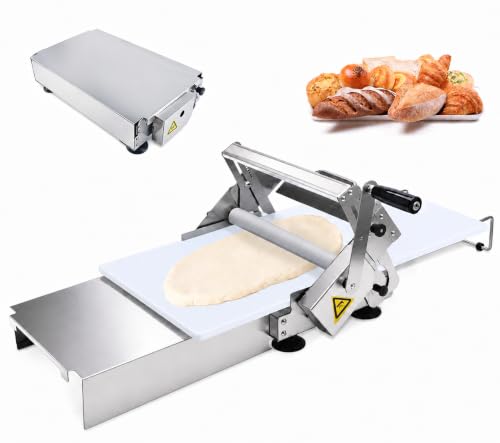
- 0–25 mm adjustment in 0.5-mm increments
- Fold-down work surfaces save storage space
- Food-grade stainless steel contact surfaces
Best For: Small commercial kitchens needing a spacious manual sheeter
Precision Space Saver

- 56 thickness settings with 0.5-mm precision
- Folds to 15.75 × 11.81 inches
- Food-grade stainless steel and alloy frame
Best For: Space-conscious bakeries needing fine manual thickness control
Best Manual Value – VEVOR Manual Dough Sheeter
For small bakeries seeking dough sheeters for small bakeries without adding electrical equipment, this VEVOR manual model offers a compact countertop setup, adjustable thickness, and stainless steel construction. Its removable parts also make routine cleaning and storage more manageable.
Best For: Small bakeries, cafés, restaurants, and home kitchens that need a manual sheeter for pastry, fondant, pasta, or pizza dough.
Pros:
- Manual operation requires no electricity.
- Adjusts from 0 to 0.5 inches for varied dough applications.
- Removable handle, panel, and roller simplify cleaning and storage.
- Fixed base and stainless steel construction support stable countertop use.
Cons:
- Manual operation requires hands-on effort.
- Its 21.65-inch length may still require dedicated counter space.
This is a practical choice when flexibility and easy maintenance matter more than automated throughput. The adjustable dial and widened inlet and outlet make it useful for varied small-batch production.
Best Wide-Bed Option – 15.5-Inch Folding Dough Sheeter
Among dough sheeters for small bakeries, this 15.5-inch folding model stands out for its extra-wide dough board and countertop-friendly manual design. It is intended to flatten larger batches evenly while remaining suitable for storage in a compact workspace.
Best For: Small bakeries, cafés, pizzerias, and home bakers handling pizza, croissants, puff pastry, fondant, tortillas, or laminated dough.
Pros:
- Extra-wide board helps roll larger batches in one pass.
- Adjustable control knob supports different thickness settings.
- Stainless steel rollers and frame are designed for food-contact use.
- Folding, detachable construction helps with storage and cleaning.
Cons:
- At 35 pounds, it is relatively heavy to move frequently.
- Manual cranking may be less suitable for high-volume production.
The wider working area can reduce repeated rolling for larger pieces of dough, while the folding structure helps offset its substantial footprint. It is a sensible fit for operations that want more working width without moving to an electric machine.
Best for Flexible Storage – 40.4-Inch Foldable Dough Sheeter
For bakeries comparing dough sheeters for small bakeries with limited storage, this foldable manual model offers adjustable 0–25 mm thickness and a space-saving design. Its hand-crank operation avoids electricity while supporting pizza, pastry, pasta, and other dough preparations.
Best For: Small bakeries, cafés, food trucks, pizza shops, and home kitchens that need broad dough versatility and compact storage.
Pros:
- Fine 0–25 mm thickness adjustment supports varied recipes.
- Foldable design helps maximize limited workspace.
- Manual operation works without electricity.
- Food-grade stainless steel dough-contact surfaces are corrosion-resistant.
Cons:
- Hand-crank operation requires manual labor.
- The supplied notes do not specify the unfolded working width.
This model is most appealing when storage flexibility is a priority. Its wide application range and precise thickness adjustment make it adaptable, while the foldable frame can help keep a busy bakery counter organized.
Best Compact Starter – 12-Inch Folding Dough Sheeter
This 12-inch folding model is a compact option among dough sheeters for small bakeries, pairing manual operation with 0–25 mm thickness adjustment. Its stainless steel build, folding mechanism, and ergonomic crank suit smaller work areas and varied baking tasks.
Best For: Apartment bakers, dessert shops, small bakeries, pizza places, and catering services needing a versatile countertop roller.
Pros:
- Fine thickness adjustment supports thin pastry and thicker pizza dough.
- Folding design reduces storage demands.
- Food-grade stainless steel rollers and frame support repeated use.
- 360-degree rotating handle and gear system are designed for smooth cranking.
Cons:
- Its 12-inch width may limit the size of dough handled in one pass.
- Manual operation is less suited to fully automated production.
Choose this model when counter and storage space are more important than maximum sheet width. It offers useful recipe flexibility in a relatively compact format, with a manual crank intended to make rolling easier than using a pin.
Compact Choice – 12-Inch Folding Dough Sheeter
For small bakeries seeking dough sheeters for small bakeries that can handle pastry work without taking over the workspace, this 12-inch manual model offers adjustable thickness from 0.1 to 20mm. Its standing design, fold-flat profile, and removable roller make it practical for regular croissants, pie crusts, and similar preparations.
Best For: Small bakeries and home kitchens that need compact storage, precise thickness control, and a back-saving standing workflow.
Pros:
- Adjusts from 0.1 to 20mm across 20 settings for varied pastry thicknesses.
- Folds flat to 4.3 inches for cabinet or under-counter storage.
- Reinforced steel frame, removable roller, non-stick surface, and a 24-month warranty.
Cons:
- Its 12-inch size may limit the width of larger dough sheets.
- Manual operation still requires turning the handle and feeding the dough.
This is a space-conscious option for bakeries prioritizing storage and repeatable thickness over high-volume production capacity. The foldable design and broad adjustment range make it especially versatile for a compact pastry station.
Wide-Format Workhorse – 40.6-Inch Foldable Manual Sheeter
Among dough sheeters for small bakeries, this foldable manual model stands out for its expanded operating footprint and 0–25mm thickness range. It uses a smooth hand-crank system and stainless steel contact surfaces for pastry, pizza, pasta, dumpling wrappers, and other dough applications.
Best For: Small bakeries, food trucks, pizza shops, and restaurants that have room for a wider manual sheeter and need broad application flexibility.
Pros:
- Dual thickness adjustment with increments as fine as 0.5mm.
- Handles dough thicknesses from 0 to 25mm for varied recipes.
- Folds from a 40.6 × 22.8 × 15.7-inch operating size to 18.5 × 11.8 × 4.7 inches.
- Reinforced alloy frame and food-grade stainless steel contact surfaces.
Cons:
- At 24.5 pounds, it is less convenient to move frequently.
- Its expanded operating dimensions require substantial counter or worktable space.
- Manual operation may be slower than an electric sheeter during heavy production.
The combination of wide working dimensions and fine adjustment suits operators who want more dough-handling flexibility than a compact countertop model. Confirm the available workspace before buying, since its operating footprint is considerably larger than its folded size.
Stainless Steel Value – Adjustable Folding Dough Sheeter
This folding stainless steel model is a straightforward option for small bakeries comparing dough sheeters for small bakeries with limited counter space. Its 12-inch manual roller adjusts from 0 to 17.5mm and includes two sheeter boards, making it suitable for croissants, puff pastry, pizza dough, bread, and other pastry preparation.
Best For: Small bakeries and home bakers wanting a food-grade stainless steel machine with adjustable thickness and foldable storage.
Pros:
- 304 stainless steel construction is food-grade, rust-resistant, and easy to clean.
- Adjustable thickness from 0 to 17.5mm supports multiple dough styles.
- Foldable design helps conserve countertop and storage space.
- Includes two sheeter boards, a hand crank, machine body, and stand.
Cons:
- The listed 12-inch format may not suit very wide production batches.
- Manual operation requires hands-on rolling.
- The supplied warranty description is limited to one year.
With food-grade stainless steel, a compact folding format, and useful included components, this model fits bakeries building a practical pastry setup on a budget-conscious footprint. It is best suited to moderate manual use rather than automated, high-throughput production.
Compact Manual Pick – Folding Stainless Steel Dough Sheeter
For small bakeries seeking dough sheeters for small bakeries without adding electrical equipment, this folding manual model offers adjustable rolling from 0 to 17.5 mm. Its two 27.5-by-12-inch PE rolling boards support different dough-preparation tasks while the stainless steel body is designed for straightforward cleanup.
Best For: Small bakeries and home baking setups that need a compact manual sheeter for pizza, pastry, pasta, and cookie dough.
Pros:
- Includes both rough and smooth rolling boards.
- Adjustable thickness from 0 to 17.5 mm.
- Folding design and non-slip base help with storage and stability.
- Stainless steel main body is washable and easy to wipe clean.
Cons:
- Manual operation requires hands-on effort.
- Its maximum thickness range is narrower than the 0-to-25-mm models in this roundup.
- The supplied notes do not specify the folded dimensions.
This is a practical choice when versatility and a smaller footprint matter more than powered throughput. The included boards and broad dough compatibility make it suitable for varied small-batch production.
Large-Surface Workhorse – Foldable Commercial Tabletop Dough Roller
This tabletop option suits small bakeries that want a generous working area without committing to an electric machine. Its 0-to-25-mm adjustment range, controlled in 0.5-mm increments, helps produce consistently sized sheets for pastry, pizza, pasta, and other dough products.
Best For: Bakeries, cafés, restaurants, and home kitchens that need a foldable manual sheeter with extended work surfaces.
Pros:
- Fine 0.5-mm adjustments across a 0-to-25-mm range.
- Fold-down work surfaces help conserve storage space.
- Food-grade stainless steel dough-contact surfaces.
- 360-degree handle and smooth gear system support controlled rolling without electricity.
Cons:
- The extended 40.5-by-22.8-inch format may require substantial counter space during use.
- Manual rolling can be more labor-intensive for larger batches.
- The supplied notes list product dimensions inconsistently, so verify the operating footprint before purchase.
Choose this model if precise thickness control and a broad working surface are priorities. Its folding structure improves storage flexibility, while the manual design avoids electrical requirements.
Precision Space Saver – Folding 0–25 mm Dough Sheeter
Among dough sheeters for small bakeries, this model balances fine adjustment with compact storage. It provides 56 thickness settings from 0 to 25 mm, folds from a 33.46-by-18.9-inch working size to 15.75-by-11.81 inches, and uses food-grade stainless steel on dough-contact surfaces.
Best For: Small bakeries and pastry shops with limited counter space that need precise manual control for varied doughs.
Pros:
- Offers 56 settings with 0.5-mm precision across a 0-to-25-mm range.
- Folds to a compact 15.75-by-11.81-inch storage size.
- High-strength alloy frame and food-grade stainless steel contact parts.
- Manual 360-degree handle and gear system require no electricity.
Cons:
- Manual operation may be less suitable for very high-volume production.
- The 33.46-by-18.9-inch operating footprint still needs adequate counter space.
- Assembly and maintenance are required, even though the design is intended to simplify both.
This is the strongest fit for space-conscious operators who value repeatable thickness settings. Its compact folded profile and broad pastry compatibility make it especially useful where storage and versatility are equally important.
How We Picked the Best Dough Sheeters for Small Bakeries
We compared these machines by the factors that matter most in a compact bakery: roller width, thickness range, adjustment precision, frame design, cleaning access, portability, and expected workload. Manual sheeters can vary significantly in footprint and working capacity, so we also considered whether each design suits a home-based business, café kitchen, pastry station, or small production bakery.
Foldable construction received particular attention because it allows operators to clear a work surface after production. Stainless steel components and removable handles can also make routine cleaning and storage simpler, but buyers should still confirm the manufacturer’s care instructions before using water or commercial cleaners.
Quick Comparison
| Feature | Why It Matters | What to Look For |
|---|---|---|
| Roller width | Determines the usable dough size per pass | About 12–16 inches for compact workstations; wider models for higher output |
| Thickness adjustment | Controls consistency across pastry and pizza recipes | A clearly marked, easy-to-use adjustment range |
| Folding design | Saves counter and storage space | Secure hinges, stable opening, and manageable folded dimensions |
| Materials | Affects durability and cleanup | Stainless steel contact surfaces and a rigid frame |
Key Buying Factors for Dough Sheeters for Small Bakeries
Roller Width and Production Volume
Choose a width based on the dough you process most often. A narrower 12-inch machine is easier to store and can suit cookies, small pastries, and limited batches. Wider 15-inch-plus models reduce the number of passes for larger pastry sheets, pizza dough, and laminated products.
Thickness Range and Adjustment
Fine adjustment matters when switching between puff pastry, pie dough, fondant, noodles, and pizza bases. Look for a broad range with stable settings and controls that are easy to read while working. Very thin settings are useful for pastry, but practical repeatability is more important than the smallest advertised measurement.
Stability, Cleaning, and Storage
A sheeter must stay firmly in place during operation. Check for a substantial frame, reliable feet or clamps, and a handle that turns smoothly. Removable parts and accessible rollers simplify cleanup, while folding models are valuable when the same table serves multiple purposes.
Who Should Buy Which Dough Sheeters for Small Bakeries?
Choose a compact 12-inch model if you have limited counter space, produce smaller batches, or need a machine for occasional pastry preparation.
Choose a wider 15-inch or 40-inch-class tabletop design if you regularly prepare larger sheets and want fewer passes. Confirm the open footprint before buying, since wide machines need substantial clearance.
Choose a stainless steel foldable model for a busy shared kitchen where durability, storage, and straightforward sanitation are priorities.
Choose a model with a broad 0–25 mm-style range if the bakery makes several dough types and needs flexibility from thin pastry to thicker pizza or bread preparations. For any commercial operation, verify the machine’s stated capacity, food-contact materials, warranty, and local electrical or sanitation requirements before placing an order.