Making your own dehydrated meals can reduce pack weight, control ingredients, and make multi-day trips easier to plan. The best food dehydrator for backpacking should dry consistently without taking up more kitchen space or time than necessary.
We compared these 10 models by capacity, temperature control, portability, timer features, tray design, and suitability for jerky, fruit, vegetables, and complete trail meals.
Best 10 Food Dehydrator for Backpacking Picks for 2026
Best Adjustable-Height Value

- 95–165°F control in 1°F increments
- Expandable from five to seven trays
- Quiet operation under 47 dB
Best For: Backpackers preparing flexible small-to-medium batches
Best Lightweight Compact Pick

- Light 3.9-pound design
- Five adjustable BPA-free trays
- Up to 72-hour operation
Best For: Beginners and small-batch backpacking prep
Best Stainless Steel Upgrade
Cosori 5-Tray Stainless Dehydrator
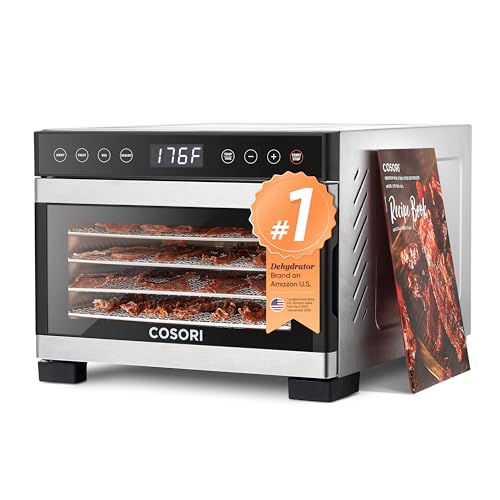
- 3.1 square feet of drying space
- 95–176°F precise temperature control
- Includes mesh screen and fruit roll sheet
Best For: Thorough home preparation before backpacking trips
Best Expandable Batch Capacity

- 600-watt even-airflow drying system
- Expandable from five to 12 trays
- Includes screens, fruit-roll sheets, and seasoning
Best For: Large-batch jerky and trail-food preparation
Compact Adjustable Pick
Seeutek 5-Tray Food Dehydrator

- Five BPA-free trays for batch drying
- 95–165°F adjustable temperature control
- Compact 5-pound countertop design
Best For: Home-prepping varied backpacking snacks and meals
Off-Grid Solar Option
JUA Technologies Solar Food Dehydrator
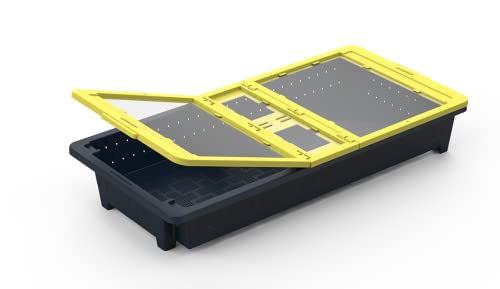
- Dries food using sunlight
- Includes hygrometer and food scraper
- Single food-safe BPA-free tray
Best For: Solar food preparation in sunny off-grid settings
Jerky-Focused Workhorse
Nesco JerkyXpress 4-Tray Dehydrator

- Fixed 160°F setting for jerky
- Expandable from four to seven trays
- Includes jerky gun and seasoning samples
Best For: Making batches of beef jerky for backpacking
Lightweight Capacity Pick
Compact Stainless Steel Dehydrator
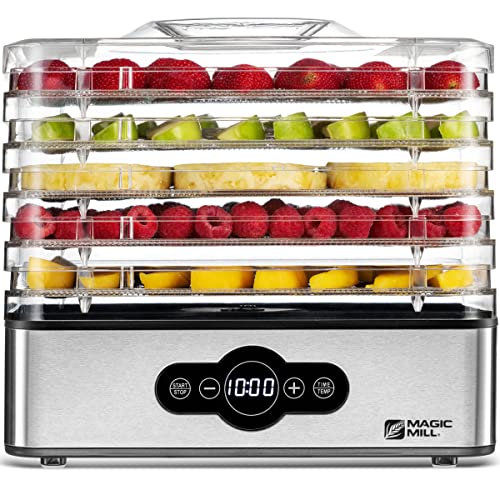
- Five adjustable stainless steel trays
- 95°F–167°F controls and 48-hour timer
- 2.75 kg listed weight for easier handling
Best For: Backpackers preparing smaller batches of trail snacks
Large-Batch Power Pick

- Eight stainless steel trays for larger batches
- 650W motor with 48-hour timer
- Mesh and drip trays included
Best For: Preparing substantial quantities of backpacking food
Balanced Batch Pick
Rosewill Adjustable-Tray Dehydrator

- Five trays with up to 1.5-inch spacing
- 400W motor with 48-hour timer
- 360° circulation and quiet operation
Best For: Compact, moderate-size trail-food preparation
Best Adjustable-Height Value – Cosori 5-Tray Food Dehydrator
If you want a practical food dehydrator for backpacking meal prep, the Cosori offers flexible temperature control, a relatively light 4.9-pound build, and five trays for preparing fruit, vegetables, herbs, or jerky before a trip.
Best For: Backpackers who want a compact, expandable dehydrator with precise controls and quiet operation.
Pros:
- Adjustable from 95–165°F in 1°F increments, with a timer that runs up to 48 hours.
- Five BPA-free trays can expand to seven and have customizable heights for thicker ingredients.
- Operates at less than 47 dB and includes a recipe book.
Cons:
- The round design measures 12.2 inches across, so it still needs meaningful counter or storage space.
- Its 350-watt output and five-tray capacity are less suited to very large batches.
This is a well-rounded choice for trip planning, especially when adjustable tray height and lower operating noise matter. Its expandable design also lets you start small and increase capacity later.
Best Lightweight Compact Pick – Small 5-Tray Food Dehydrator
For a space-conscious food dehydrator for backpacking preparation, this model combines a 3.9-pound weight with five stackable trays, straightforward knob controls, and a compact rectangular footprint suited to small kitchens, RVs, or dorms.
Best For: Beginners and backpackers making small batches of dried fruit, herbs, jerky, vegetables, or pet treats.
Pros:
- Its 250-watt system is designed for energy-efficient small-batch drying.
- Five transparent, height-adjustable BPA-free trays make it easy to monitor food and accommodate different ingredient thicknesses.
- Temperature adjusts from 95–158°F, and operation can continue for up to 72 hours.
- Dishwasher-safe trays simplify cleanup, provided the dishwasher temperature stays below 158°F.
Cons:
- The 158°F maximum offers less temperature range than some competing models.
- Its compact capacity is better suited to small batches than large-scale meal preparation.
This is an approachable option when low weight and simple operation take priority. It is especially practical for testing dehydration recipes before committing to a larger machine.
Best Stainless Steel Upgrade – Cosori 5-Tray Stainless Dehydrator
This Cosori is a strong food dehydrator for backpacking meal preparation when you want stainless steel food-contact surfaces, more drying area, and precise controls in a countertop design.
Best For: Backpackers who prioritize stainless steel trays, even airflow, and broad temperature control over minimum pack weight.
Pros:
- Five stainless steel trays provide 3.1 square feet of drying space with no plastic contact with food.
- Temperature adjusts from 95–176°F in 1°F increments, with four presets for jerky, fruit, vegetables, and yogurt.
- Rear horizontal airflow is designed to promote even dehydration without tray rotation.
- Includes a mesh screen, fruit roll sheet, recipe book, and 48-hour timer.
Cons:
- At 10.8 pounds, it is substantially heavier than the other compact options here.
- Its 13.9-by-11.3-inch footprint may be less convenient for limited storage.
The stainless construction and included accessories make this a capable choice for serious batch preparation. However, its weight makes it better for home-based trip prep than for carrying into the backcountry.
Best Expandable Batch Capacity – NESCO Snackmaster Pro
NESCO FD-75A Snackmaster Pro Food Dehydrator, For Snacks, Fruit, Beef Jerky, Gray
Check Price On AmazonThe NESCO Snackmaster Pro is a useful food dehydrator for backpacking preparation when you need dependable airflow and the option to scale from a small batch to a larger supply of trail snacks.
Best For: Backpackers, hunters, gardeners, and families preparing larger quantities of jerky, fruit, and vegetables.
Pros:
- The 600-watt Converga-Flow system circulates heat evenly without requiring tray rotation.
- Capacity can expand from five trays to as many as 12 trays for larger preparation sessions.
- Adjustable temperature control spans 95–160°F.
- The top-mounted fan helps keep liquids away from the heating element and includes fruit roll sheets, Clean-A-Screens, and jerky seasoning.
Cons:
- Its 13-inch round footprint and 10-inch height require substantial storage space.
- The one-year limited warranty is shorter than the two-year warranties listed for the Cosori models.
- Its listed 3.5 kg weight makes it less convenient to transport than the lightest option.
Choose this model if expandable capacity matters more than compact storage. Its airflow system and included accessories make it well suited to repeated, larger-scale trail-food preparation.
Compact Adjustable Pick – Seeutek 5-Tray Food Dehydrator
For a countertop food dehydrator for backpacking meal prep, the Seeutek offers five BPA-free trays, adjustable temperature control, and a compact 5-pound design. Its 95–165°F range supports drying fruits, vegetables, herbs, and jerky before a trip.
Best For: Backpackers and DIY snack makers who want flexible temperature settings and multiple trays for preparing assorted trail foods.
Pros:
- Adjustable 95–165°F temperature range for different ingredients.
- Five BPA-free trays can be rotated to accommodate different food sizes.
- Transparent design lets you monitor drying without opening the lid.
- Includes reusable storage bags, a recipe book, and a two-year manufacturer warranty.
Cons:
- Its 240-watt electric operation requires access to a suitable power source.
- At 5 pounds, it may be less convenient to transport than a lightweight drying solution.
The Seeutek is a practical home-prep option when you want control over drying temperatures and enough capacity for several trail-food ingredients at once. It is best suited to preparing backpacking food at home rather than carrying the appliance into the backcountry.
Off-Grid Solar Option – JUA Technologies Solar Food Dehydrator
For a food dehydrator for backpacking that does not depend on electricity, the JUA Technologies Dehytray uses sunlight to speed drying in a mini-greenhouse-style tray. It can help prepare fruits, vegetables, herbs, fruit leathers, and jerky for outdoor trips.
Best For: Campers, homesteaders, and off-grid users who have dependable sunlight and want a simple solar drying method.
Pros:
- Uses solar heat instead of an electrical power source.
- Helps protect food from dust, pollen, and most pests during sun drying.
- Includes a hygrometer for monitoring drying conditions and a scraper for food removal.
- Uses 100% BPA-free, food-grade material and requires no assembly.
Cons:
- Drying depends on available sunlight and outdoor conditions.
- Its single-tray design offers less capacity than multi-tray electric dehydrators.
- The 5-pound unit is not especially lightweight for carrying on a backpacking trip.
The Dehytray is a distinctive choice for preparing backpacking food without grid power, but it is more suitable for home, campsite, or off-grid use than for being packed during a hike. Its performance will naturally vary with weather and sunshine.
Jerky-Focused Workhorse – Nesco JerkyXpress 4-Tray Dehydrator
Nesco FD-28JX JerkyXpress Food Dehydrator with Accessories for Beef Jerky, 4 Trays, White
Check Price On AmazonIf jerky is central to your backpacking food plan, the Nesco FD-28JX provides fixed 160°F drying, 350 watts of power, and four trays that can expand to seven. The included jerky gun and seasoning samples make it especially geared toward preparing meat snacks for the trail.
Best For: Backpackers who regularly make beef jerky and want a straightforward dehydrator with expandable capacity.
Pros:
- Fixed 160°F temperature simplifies jerky preparation.
- 350-watt power provides even heat distribution for consistent drying.
- Four trays can expand to seven without tray rotation.
- Includes a jerky gun, three tips, seasoning and cure samples, and a recipe book.
Cons:
- Fixed temperature offers less flexibility for foods that require different settings.
- Additional trays for expansion are sold separately.
- It requires electrical power for operation.
The JerkyXpress is a focused, easy-to-use choice for producing protein-rich backpacking snacks at home. Choose it over a variable-temperature model if jerky is your priority; choose another design if you need broader control for delicate foods or herbs.
Lightweight Capacity Pick – Compact Stainless Steel Dehydrator
For a food dehydrator for backpacking, the Magic Mill offers a relatively compact five-tray design with straightforward digital controls. Its 240W motor, adjustable trays, and 48-hour timer suit users preparing shelf-stable snacks such as fruit, vegetables, herbs, and jerky before a trip.
Best For: Backpackers who want a compact dehydrator for smaller batches and varied ingredients.
Pros:
- Five stainless steel trays can be adjusted for thicker ingredients.
- Temperature control ranges from 95°F to 167°F with a timer up to 48 hours.
- Detachable trays are washable by hand or in a dishwasher.
- Its listed weight is 2.75 kg, making it easier to manage than many larger dehydrators.
Cons:
- The 240W capacity may be less suited to very large batches.
- It has only five trays, so high-volume meal preparation may require multiple cycles.
The Magic Mill is a practical choice when portability and flexible tray spacing matter more than maximum batch size. Its timer and adjustable temperature controls also make unattended drying more convenient.
Large-Batch Power Pick – 8-Tray Food Dehydrator
This food dehydrator for backpacking is designed for users who want to prepare substantial quantities of trail food at once. The 650W motor, eight stainless steel trays, and included mesh and drip trays provide useful capacity for jerky, fruit, herbs, seeds, and fruit roll-ups.
Best For: Backpackers, families, or trip planners preparing large batches before extended outings.
Pros:
- Eight stainless steel trays provide more batch capacity than the five-tray models here.
- Includes a mesh tray for small foods and a drip tray for juicy ingredients.
- Offers temperature settings up to 167°F and a timer up to 48 hours.
- Features auto shut-off, a viewing light, and a stated quiet-operation design.
Cons:
- Its 13.00 × 13.31 × 12.01-inch footprint is larger than the compact alternatives.
- The 650W motor may use more electricity than lower-wattage options.
Choose this model if batch size is your priority. It is less space-conscious than the smaller dehydrators, but the extra trays and accessories can reduce the number of drying cycles needed before a trip.
Balanced Batch Pick – Rosewill Adjustable-Tray Dehydrator
For shoppers seeking a food dehydrator for backpacking with a balance of power and countertop size, the Rosewill combines a 400W motor with five adjustable trays. Its 360° hot-air circulation, quiet operation, and automatic shut-off are useful for preparing jerky, fruit, herbs, vegetables, and other trail foods.
Best For: Users who want adjustable tray spacing and moderate batch capacity in a compact rectangular design.
Pros:
- Five trays can be repositioned to accommodate ingredients up to 1.5 inches high.
- Offers a 0.5- to 48-hour timer and temperature control beginning at 95°F.
- 360° hot-air circulation is designed for even drying.
- Quiet operation, non-slip feet, and dishwasher-compatible tray cleaning add convenience.
Cons:
- The listed item weight is 14.7 pounds, which is relatively heavy for a compact unit.
- Its five-tray capacity is smaller than the eight-tray alternative.
- The supplied specifications list different upper temperature figures, so buyers should verify the current product details.
The Rosewill stands out for flexible tray spacing and practical controls. It makes sense for backpackers who value a compact footprint and adjustable capacity but do not need an eight-tray machine.
How We Picked the Best Food Dehydrator for Backpacking
We focused on features that matter before a trip: dependable low-temperature drying, useful tray capacity, straightforward controls, and practical storage. We also considered whether each model suits backpackers who prepare small batches, families making several days of meals, or users primarily drying jerky and snacks.
Electric models were assessed for adjustable heat, timers, airflow design, tray materials, and wattage. The solar option offers a different approach for users prioritizing off-grid operation, although it depends more heavily on weather and setup conditions.
Quick Comparison
| Best For | What to Look For |
|---|---|
| Solo backpackers | Compact size, modest tray count, and easy storage |
| Meal prep | Multiple trays, even airflow, and long timer settings |
| Jerky and snacks | Adjustable temperature and dedicated accessories |
| Off-grid use | Solar operation and low dependence on household power |
| Frequent use | Durable trays, simple cleaning, and consistent controls |
Key Buying Factors for a Food Dehydrator for Backpacking
Size and Drying Capacity
A compact five-tray unit can be enough for one or two hikers, while larger eight-tray machines make sense when preparing meals for a group or several trips at once. Remember that the dehydrator stays at home; its packed size matters mainly for storage, not for carrying on the trail.
Temperature Control
Adjustable heat is more versatile than a single preset. Lower temperatures help preserve the texture of fruits, vegetables, and herbs, while higher settings are useful for appropriate jerky preparation. Follow tested food-safety guidance for meat rather than relying on the appliance alone.
Timer and Overnight Convenience
A 48-hour timer can simplify long drying cycles and reduce the need to monitor the machine. Automatic shutoff is especially useful if you dehydrate while completing other meal-prep tasks.
Trays, Airflow, and Cleaning
Stainless-steel trays are durable and easy to inspect, while BPA-free plastic trays may keep the overall price and weight lower. Removable, washable components and even airflow are more valuable than decorative controls or excessive capacity.
Power and Noise
Wattage affects energy use and may influence drying speed, but it is not the only performance measure. Check your available outlet, expected operating time, and tolerance for fan noise before choosing a model.
Who Should Buy Which Food Dehydrator for Backpacking?
Choose a compact five-tray dehydrator if you are a solo or occasional backpacker who wants homemade fruit, vegetables, and lightweight meals without a large appliance. A stainless-steel model is better for frequent users who value durability and repeated cleaning. Larger eight-tray machines suit families and organized meal-prep sessions, while jerky-focused models are practical for snack makers who want dedicated accessories and a simpler setup.
Consider the solar dehydrator only if off-grid operation is central to your plans and you can accept weather-dependent drying. For most home-based backpacking preparation, an electric model with adjustable temperature, a long timer, and removable trays offers the most predictable results.