The best food strainer machines make quick work of removing skins, seeds, and pulp from tomatoes, apples, berries, and other produce. The right model can turn a large harvest into smooth sauce or puree with far less effort than hand-processing.
This roundup includes manual clamp-style strainers, stand-mixer attachments, colanders, and electric tomato mills. Use the buying guide below to match capacity, power, cleanup, and batch size to your kitchen or preserving setup.
Best 10 Food Strainer Machines Picks for 2026
Best Electric Pick
Johnny Model 250 Food Strainer with Motor

- Includes four screens for varied textures
- Hand crank and electric motor options
- Five-year warranty with sturdy clamp mount
Best For: Frequent sauce, puree, jam, and juice making
Best Hand-Crank Classic
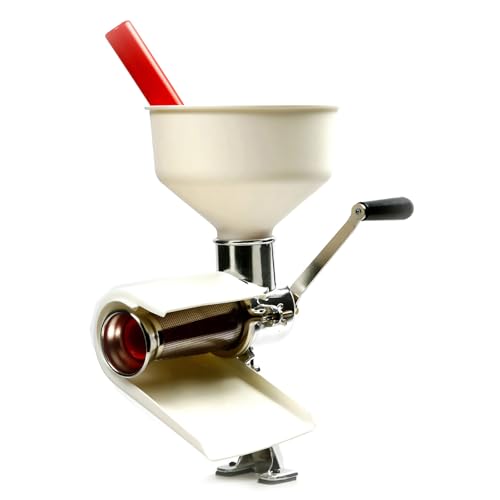
- 3-quart capacity for everyday batches
- Separates juice and pulp manually
- Specialty screens available separately
Best For: Simple manual sauce and puree preparation
Best KitchenAid Accessory Set
InnoMoon Fruit and Vegetable Strainer

- Strains cooked produce through a KitchenAid mixer
- Includes meat grinder and sausage accessories
- Removable parts are dishwasher safe
Best For: KitchenAid owners wanting straining and grinding versatility
Best Budget-Ready Basic
Johnny Model 250 Manual Food Strainer

- Focused setup for apple and tomato sauces
- Optional motor and screens expand capability
- Secure clamp fits many countertop thicknesses
Best For: Manual home preserving with room to add accessories
Versatile Kitchen Set
3-Piece Stainless Steel Colander Set

- Three nesting sizes: 3, 4, and 5 quarts
- Rust-resistant 18/8 stainless steel construction
- Suitable for draining, rinsing, sifting, and steaming
Best For: Home cooks needing flexible manual strainers for everyday preparation
Electric Sauce Maker
Weston Deluxe Electric Tomato Strainer

- 250-watt motor with forward and reverse speeds
- One-gallon hopper for larger batches
- Includes three stainless steel screens
Best For: Canning and processing bulk tomatoes, fruits, and vegetables
Manual Preserving Tool
Weston Stainless Steel Tomato Strainer
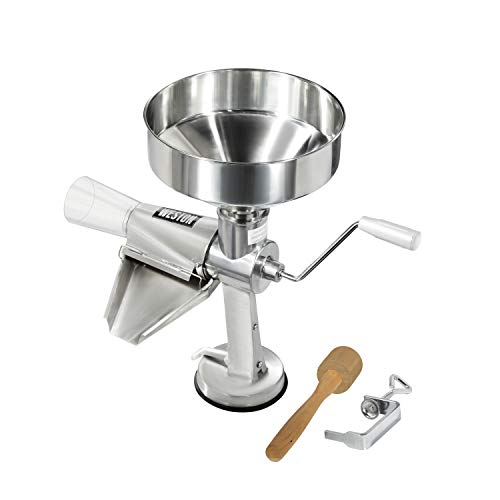
- One-gallon stainless steel hopper
- Dual suction-cup and C-clamp mounting system
- Includes stomper and 1.5mm screen
Best For: Manual processing of tomatoes, apples, sauces, jams, and preserves
High-Volume Harvest Pick

- 370W motor for large batches
- Large hopper reduces refills
- Tool-free disassembly for cleaning
Best For: Bulk sauce making and harvest-season canning
Most Versatile Screen Set
VEVOR 800W Max Tomato Strainer

- Includes four interchangeable screens
- Supports sauces, jams, purees, and salsa
- Guard helps limit juice splatter
Best For: Multi-texture food processing
Commercial-Style Motor Pick

- 370W pure copper motor
- Nine-inch fruit-feeding funnel
- Adjustable trough helps guide sauce
Best For: Frequent tomato and fruit-sauce processing
Best Electric Pick – Johnny Model 250 Food Strainer with Motor
For shoppers comparing food strainer machines, the Johnny Model 250 stands out as a flexible option for sauces, purees, jams, juices, and more. It combines a hand crank with an included electric motor and provides multiple screens for different textures.
Best For: Home cooks who want broad fruit-and-vegetable straining capability with electric assistance.
Pros:
- Includes berry, apple/tomato, pumpkin, and salsa screens.
- Electric motor can replace the hand crank for easier processing.
- Strong clamp fits countertops from 3/4 to 2-1/8 inches thick.
- Cast aluminum body, stainless steel screens, and a five-year warranty.
Cons:
- At 8 pounds, it is relatively substantial to move and store.
- The clamp requires a suitable countertop edge for secure mounting.
Its included motor and extensive screen selection make this a particularly complete food strainer machine for frequent seasonal preserving and varied recipes.
Best Hand-Crank Classic – Norpro 1951 Sauce Master
The Norpro 1951 is a straightforward choice among food strainer machines, using a hand crank to push produce through a chrome-plated steel screen while separating juice and pulp. Its 3-quart capacity suits routine batches of fruits, vegetables, and purees.
Best For: Buyers seeking a simple hand-operated sauce and puree strainer.
Pros:
- Separates juice and pulp in one manual operation.
- Includes a fine mesh screen, standard spiral, recipe, and instruction booklet.
- Offers a 3-quart, or 95-ounce, capacity.
- Additional berry, pumpkin, and salsa screens are available separately.
Cons:
- Additional specialty screens are not included.
- Hand wash only, according to the listed product highlight.
This is a practical, traditional sauce maker when you prefer manual control and do not need the broader accessory package of an electric model.
Best KitchenAid Accessory Set – InnoMoon Fruit and Vegetable Strainer
If you already own a compatible KitchenAid stand mixer, this InnoMoon set expands it into a food strainer machine for cooked fruits and vegetables. The package also includes a meat grinder attachment, making it useful beyond sauce and puree preparation.
Best For: KitchenAid owners who want straining and grinding functions in one accessory bundle.
Pros:
- Strainer filters out stems, seeds, and skins from cooked produce.
- Includes a meat grinder with two plates, two blades, and sausage-stuffer tubes.
- Removable parts are dishwasher safe or can be hand-washed.
- Cleaning brush and recipe ideas are included.
Cons:
- Requires a KitchenAid stand mixer to operate.
- Hard or firm produce should be cooked before straining.
- The listed material is plastic.
This set is best viewed as a multifunctional mixer attachment rather than a standalone appliance, especially for cooks who also want homemade ground meat and sausages.
Best Budget-Ready Basic – Johnny Model 250 Manual Food Strainer
The basic Johnny Model 250 is a focused option for shoppers comparing food strainer machines without needing an included motor or multiple screens. It uses a hand crank and apple/tomato screen to remove skins and seeds for sauces, purees, fillings, and juices.
Best For: Home preservers who want a durable manual strainer with the option to add accessories later.
Pros:
- Includes a 1.3mm apple/tomato screen and standard spiral.
- Handles sauces, purees, pie fillings, juices, jams, soups, and baby foods.
- Clamp mounts to countertops from 3/4 to 2-1/8 inches thick.
- Cast aluminum construction and stainless steel screen come with a five-year warranty.
Cons:
- Electric motor is optional and sold separately.
- Berry, pumpkin, salsa, and grape accessories are extra.
Choose this model if your main goal is reliable hand-cranked tomato or apple processing and you prefer to expand the setup only when needed.
Versatile Kitchen Set – 3-Piece Stainless Steel Colander Set
For shoppers comparing food strainer machines and everyday kitchen strainers, this three-piece stainless steel set covers routine draining, rinsing, sifting, and steaming. Its nested 3-, 4-, and 5-quart baskets provide useful size flexibility without taking up much storage space.
Best For: Home cooks who want versatile manual strainers for pasta, produce, grains, dry ingredients, and steaming.
Pros:
- Food-grade 18/8 stainless steel is BPA-, lead-, and cadmium-free and designed to resist rust.
- Three sizes handle different preparation and draining tasks.
- Riveted handles, sturdy rims, and resting bases support stable use.
- Nesting storage and dishwasher-safe construction simplify cleanup.
Cons:
- This is a manual colander set, not a powered straining machine.
- The set may be more than needed if you only want one strainer size.
Choose this set for broad kitchen utility and convenient storage. It is especially practical when you need separate baskets for rinsing produce, draining pasta, sifting ingredients, or steaming.
Electric Sauce Maker – Weston Deluxe Electric Tomato Strainer
Among food strainer machines, the Weston Deluxe is built for quickly processing soft fruits and vegetables into sauces, purees, jellies, and salsa. Its electric motor, large hopper, reverse function, and interchangeable screens make it suited to larger preserving projects.
Best For: Garden harvests, bulk produce processing, canning, and making smooth or chunky sauces with less manual effort.
Pros:
- 250-watt motor offers forward and reverse speeds to support processing and help prevent jams.
- One-gallon hopper accommodates larger batches.
- Three stainless steel screens provide 1.5mm, 3mm, and 6mm straining options.
- Removes skins and separates seeds without requiring coring for tomatoes and other soft produce.
Cons:
- Its 120-volt AC power requirement limits use to locations with a suitable outlet.
- The electric design is larger and less portable than a manual food mill.
This model is a strong fit when speed and batch capacity matter more than compact storage. The screen selection also gives it more flexibility than a single-purpose tomato strainer.
Manual Preserving Tool – Weston Stainless Steel Tomato Strainer
For buyers considering food strainer machines without adding a motor, this Weston manual tomato strainer offers a straightforward way to separate skins and seeds from soft produce. Its one-gallon hopper and surface-mounting options make it practical for kitchen or garden-table processing.
Best For: Users who prefer manual control for tomato sauce, jams, preserves, salsa, and basic fruit or vegetable purees.
Pros:
- Stainless steel hopper, handle, splash guard, and chute support durable, cleaner processing.
- One-gallon hopper is suited to larger batches.
- Dual mount system uses a suction-cup base and C-clamp for attachment to compatible flat surfaces.
- Includes a stomper and 1.5mm screen for tomatoes and apples.
Cons:
- Manual operation requires more effort than the electric Weston model.
- Only the 1.5mm screen is included; the additional accessory kit is sold separately.
This is a sensible choice for preserving enthusiasts who want a sturdy, non-electric setup. The mounting flexibility and splash guard add convenience, while the optional accessory kit can expand puree and sauce applications.
High-Volume Harvest Pick – VEVOR 370W Tomato Strainer
Among food strainer machines, this VEVOR model is designed for larger tomato-processing jobs. Its 370W motor, large hopper, and stainless steel filter help produce smoother sauce, puree, and juice while reducing repeated straining.
Best For: Bulk tomato sauce making, harvest-season canning, and users who want a durable, easy-to-rinse machine.
Pros:
- Separates peels and seeds in a single pass.
- Large hopper and 370W motor support high-volume processing.
- Stainless steel food-contact components are built for frequent use.
- Core parts disassemble without tools for quicker cleanup.
Cons:
- At 21.7 pounds, it is relatively heavy to move and store.
- Tomatoes should be cut into smaller pieces to help reduce clogging.
This is a practical choice when throughput and durability matter more than compact storage. Its straightforward, tool-free cleanup also suits frequent canning sessions.
Most Versatile Screen Set – VEVOR 800W Max Tomato Strainer
This VEVOR is one of the more adaptable food strainer machines for home sauce and puree projects. It includes four screens, allowing you to adjust textures for tomato sauce, jam, pumpkin puree, salsa, and other preparations.
Best For: Cooks who want multiple texture options and a lighter machine for varied small- to large-batch food processing.
Pros:
- Four screens provide 1mm, 1.5mm, 3mm, and 6mm texture options.
- Steady DC motor output is designed for continuous sauce making.
- 304 stainless steel parts resist fruit acids and wear.
- Guard cover helps reduce splatter during straining.
Cons:
- The listed rated power is 300W, despite the 800W maximum title rating.
- Its stated throughput is 88 pounds per hour, lower than the highest-capacity options here.
The interchangeable screens make this model a strong fit for users who prepare different foods and prefer control over final texture. A supplied cleaning brush adds convenience after processing.
Commercial-Style Motor Pick – VBENLEM 370W Tomato Press
For shoppers comparing food strainer machines with commercial-style construction, this VBENLEM model combines a 370W pure copper motor with stainless steel food-contact parts. Its wide funnel and adjustable trough are designed to make feeding and sauce discharge more manageable.
Best For: Users processing tomatoes and fruit sauces who want a sturdy 110V machine with a large feeding funnel.
Pros:
- 370W pure copper motor is enclosed in a stainless steel casing.
- 304 stainless steel food-contact parts are easy to disassemble and clean.
- Nine-inch funnel supports steady feeding of fruits.
- Adjustable trough and brace help direct sauce and reduce splashing.
Cons:
- At 22 pounds, it is not especially portable.
- The 110V design requires a compatible electrical supply.
- The supplied notes describe the body material as aluminum, rather than full stainless steel.
This machine suits buyers prioritizing motor construction, feeding capacity, and guided discharge. Its low-noise operation and cleaning-focused design are useful for repeated sauce-making sessions.
How We Picked the Best Food Strainer Machines
We organized these Food Strainer Machines around the jobs buyers most commonly need to handle: making tomato sauce, applesauce, salsa, pumpkin puree, jams, and other smooth preparations. The selection covers manual, electric, attachment-based, and general-purpose straining designs so you can compare convenience with cost and control.
Key considerations included the strainer’s intended produce, hopper and batch capacity, construction materials, drive method, expected output, ease of disassembly, and whether the design separates skins and seeds in one pass. Because manufacturer capacity ratings can vary by produce and operating conditions, treat them as useful benchmarks rather than guaranteed results.
Quick Comparison
| Type | Best for | Main advantage | Potential trade-off |
|---|---|---|---|
| Manual clamp strainer | Small to medium home batches | Affordable and simple to operate | Requires hand cranking |
| Stand-mixer attachment | Existing KitchenAid owners | Uses equipment you already own | Depends on mixer compatibility |
| Electric mill | Frequent or large-batch processing | Faster, less manual effort | Higher price and more parts to clean |
| Colander or sieve set | Draining and basic straining | Versatile for everyday cooking | Usually does not automatically separate skins and seeds |
Key Buying Factors for Food Strainer Machines
Manual or Electric Operation
Manual models are practical for occasional batches and do not require an outlet. Electric machines are better when processing bushels of tomatoes or repeated batches, but check voltage, motor rating, noise, and duty-cycle guidance before buying.
Capacity and Throughput
Look at hopper size and the maker’s hourly output, while considering that soft, ripe produce generally processes more easily than fibrous or under-ripe ingredients. A larger hopper reduces refilling, but it can also make storage and cleanup less convenient.
Materials and Stability
Stainless steel components resist staining and are a sensible choice for acidic tomato mixtures. For clamp-based designs, confirm that your counter can accommodate the clamp. Electric units should have a stable base and a secure chute or hopper.
Cleaning and Screen Options
Removable screens and augers simplify cleanup. Check whether replacement screens are available and whether the included screen suits your preferred texture. Some machines produce a smoother puree, while others leave more pulp.
Who Should Buy Which Food Strainer Machines?
Choose a manual clamp model if you make occasional applesauce, salsa, or tomato sauce and want a compact, budget-conscious tool. Choose a stand-mixer attachment if you already own a compatible KitchenAid mixer and want to avoid another motorized appliance.
Choose an electric mill if you preserve frequently, process large harvests, or value speed over compact storage. Commercial-style machines make the most sense for serious home preservers, community kitchens, or small food businesses that can support their larger footprint and electrical requirements.
Choose a colander and sieve set for general kitchen tasks such as draining pasta, rinsing produce, and straining stocks. It is the most flexible option, but it will require more hands-on work for separating tomato skins and seeds than a dedicated food mill.