Small bakeries need pasta equipment that balances consistency, speed, footprint, and operating cost. The right machine can simplify fresh lasagna, fettuccine, tagliolini, noodles, and filled-pasta prep without overwhelming a compact kitchen.
This roundup compares 10 manual and electric options, including Italian-made classics, motorized rollers, automatic noodle makers, and heavier-duty commercial-style machines.
Best 10 Pasta Machines for Small Bakeries Picks for 2026
Classic Manual Pick

- 10 thickness settings
- Makes three pasta styles
- Compact chrome-steel design
Best For: Hands-on small-bakery pasta production
Compact Electric Value

- 135W automatic operation
- Eight settings from 0.5–3.5 mm
- Two included noodle cutters
Best For: Small spaces and mixed noodle or dumpling production
Wide-Sheet Manual Choice

- Chrome-plated steel body
- 10 listed settings
- Handles three classic pasta styles
Best For: Manual production of wider pasta sheets
Italian Electric Workhorse

- Built-in electric motor
- Heavy-duty 18-10 stainless steel
- Two cutters for tagliatelle and fettuccine
Best For: Quick production of two classic pasta cuts
Versatile Italian Classic

- Made and assembled in Italy
- Includes ravioli and spaghetti attachments
- 10 thickness settings for five pasta shapes
Best For: Small bakeries producing varied fresh pasta manually
Compact Electric Workhorse

- 135W automatic pressing and cutting
- Stainless-steel body with three noodle formats
- Stated efficiency up to 22 lb/h
Best For: Small operations prioritizing powered, compact production
Heavy-Duty Italian Foundation

- Italian chromed-steel construction
- 150 mm sheets with six roller heights
- Compatible with a separate electric motor
Best For: Bakeries seeking durable manual equipment with expansion options
Heavy-Duty Pick
LeoneBeBe Commercial Electric Pasta Maker

- Up to 55 lb/hr stated noodle capacity
- Kneads, sheets, and cuts automatically
- 3 mm and 9 mm cutters with adjustable thickness
Best For: Small businesses prioritizing production capacity and multifunctional dough handling
Precision Upgrade
Marcato Atlas Electric Pasta Machine
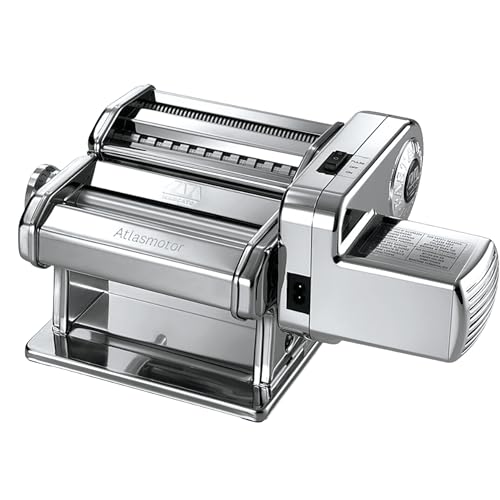
- 110V motor assists the classic Atlas machine
- 10 thickness settings for precise sheets
- Makes lasagna, fettuccine, and tagliolini
Best For: Small bakeries focused on controlled thickness and classic pasta formats
Versatile Starter
VEVOR 8-Shape Automatic Pasta Maker

- Eight discs for varied pasta shapes
- 500 g flour capacity and four automatic modes
- Includes measuring cups and cleaning accessories
Best For: Small-batch bakery kitchens experimenting with fresh pasta variety
Classic Manual Pick – Marcato Atlas150
MARCATO Atlas150 Manual Pasta Maker Machine-LASAGNA, FETTUCCINE & TAGLIOLINI. Made in Italy
Check Price On AmazonFor small bakeries seeking dependable pasta machines for small bakeries, the Marcato Atlas150 offers manual control in a compact chrome-steel design. Its 10 settings cover sheets from 0.8 to 4.8 mm, while the included cutters handle lasagna, fettuccine, and tagliolini.
Best For: Small bakery teams that prefer hands-on production and flexible sheet-thickness control.
Pros:
- 10 thickness settings from 0.8 to 4.8 mm
- Produces lasagna, fettuccine, and tagliolini
- Chrome-plated and nickel-plated steel construction
- Compact 8 x 8 x 7-inch footprint
Cons:
- Manual operation requires hands-on effort
- Only a crank handle and user manual are listed as included components
The Atlas150 is a practical choice when control and versatility matter more than automation. Its 2.6 kg build is manageable for countertop use, though higher-volume operations may prefer an electric model.
Compact Electric Value – 135W Dough Sheeter
This 135W electric machine is designed for pasta machines for small bakeries that need quicker, more consistent rolling without a large footprint. It offers eight settings, a 5.51-inch sheet width, two noodle cutters, and one-click operation.
Best For: Compact bakery workspaces making noodles, dumpling skins, and narrow pasta sheets.
Pros:
- 135W motor supports powered rolling and cutting
- Eight thickness settings from 0.5 to 3.5 mm
- Includes 1.5 mm and 4 mm noodle cutters
- Small footprint for countertop or cupboard storage
Cons:
- Sheet width is limited to 5.51 inches
- Plastic and iron components are included alongside stainless steel
With automatic operation and a space-saving design, this model suits smaller production areas. Its narrower sheet width makes it more specialized than wider manual rollers, but the powered workflow can reduce repetitive effort.
Wide-Sheet Manual Choice – Marcato Atlas 180
The Marcato Atlas 180 gives bakeries considering pasta machines for small bakeries a wider manual working format. Its chrome-plated steel body and anodized aluminum rollers are designed for lasagne, fettuccine, and tagliolini, with 10 listed settings.
Best For: Small bakeries that want a sturdy manual machine for wider pasta sheets.
Pros:
- Chrome-plated steel construction made and assembled in Italy
- Designed for lasagne, fettuccine, and tagliolini
- 10 listed thickness settings
- Anodized aluminum rollers for food processing
Cons:
- Manual operation requires continuous hand cranking
- At 3.16 kg, it is heavier than the Atlas150
- Hand washing is recommended
The Atlas 180 emphasizes material quality and a wider format over automation. It is a strong fit for operators who value manual control and Italian construction, provided the available counter space can accommodate its 9 x 7.5 x 6-inch body.
Italian Electric Workhorse – Imperia Pasta Presto
Electric Pasta Maker- Imperia Pasta Presto Non-stick Machine w 2 Cutters and 6 Thickness Settings
Check Price On AmazonThe Imperia Pasta Presto is an electric option for pasta machines for small bakeries that want faster preparation with built-in cutting functions. Its heavy-duty 18-10 stainless steel construction, non-stick coating, two cutters, and six thickness settings support a streamlined workflow.
Best For: Small bakery operations prioritizing electric convenience for tagliatelle and fettuccine.
Pros:
- Built-in motor supports quicker pasta preparation
- Heavy-duty 18-10 stainless steel construction
- Non-stick coating is designed for clean pasta production
- Includes tagliatelle and fettuccine cutters
Cons:
- Six settings provide less adjustment than some 10-setting models
- Listed dimensions are 9 x 6.5 x 12.5 inches, making it relatively tall
- Supplied details list a 1.9 mm minimum and maximum sheet thickness
The Pasta Presto is a focused electric machine for bakeries that mainly need two familiar pasta cuts. Its stainless construction and motor favor convenience, while the narrower listed thickness information makes it less versatile for varied sheet styles.
Versatile Italian Classic – Marcato Pastaset Gift Set
For small bakeries looking for pasta machines for small bakeries, the Marcato Pastaset is a flexible manual option with included ravioli and spaghetti attachments. Its 10-position adjustment knob supports a broad range of sheet thicknesses for several pasta styles.
Best For: Small bakeries that value Italian construction and multiple pasta shapes without moving to an electric machine.
Pros:
- Made and assembled in Italy.
- Includes the Atlas 150 machine, hand crank, clamp, ravioli attachment, and spaghetti attachment.
- Creates lasagne, fettuccine, tagliolini, spaghetti, and ravioli.
- Offers 10 thickness settings from 0.6 to 4.8 mm.
Cons:
- Manual operation requires staff-powered cranking.
- Additional Marcato accessories are sold separately.
- Cleaning requires allowing residue to dry before brushing it away.
The included cutters make this a well-rounded choice for a bakery producing varied fresh pasta in modest batches. Consider an electric model instead if throughput and reduced manual effort are the main priorities.
Compact Electric Workhorse – WICHEMI 3-in-1 Pasta Maker
Among pasta machines for small bakeries, the WICHEMI stands out for automatic operation and a stated efficiency of up to 22 pounds per hour. Its 135W motor presses dough and cuts several noodle styles from a compact stainless-steel body.
Best For: Small bakery counters, breakfast shops, and similar operations that need powered noodle production in a compact footprint.
Pros:
- Automatic 3-in-1 operation for pressing dough and cutting noodles.
- 304 food-grade stainless-steel construction.
- Produces 2.5 mm round noodles plus 4 mm and 9 mm flat noodles.
- Compact 8.66-by-6.88-by-8.66-inch design with stated 22 lb/h efficiency.
Cons:
- Its listed formats are more limited than machines with multiple interchangeable accessories.
- At 17.6 pounds, it is portable but not especially lightweight.
- The supplied specifications list a 1.5-to-4 mm sheet-thickness range.
The WICHEMI is the most convenience-focused option here, particularly where consistent powered output matters. Its three built-in noodle formats may be less suitable for bakeries seeking a wider range of traditional pasta shapes.
Heavy-Duty Italian Foundation – Imperia IPasta Classic Line
The Imperia IPasta Classic Line is a durable manual candidate among pasta machines for small bakeries, combining chromed steel construction with a 150 mm sheet width. Its adjustable rollers handle lasagna, fettuccine, and tagliolini, while the side slot supports a compatible electric motor.
Best For: Small bakeries wanting a sturdy manual machine that can expand with accessories or a compatible motor.
Pros:
- Made entirely in Italy with chromed steel construction.
- Produces sheets up to 150 mm wide, 6.5 mm fettuccine, and 2 mm tagliolini.
- Six roller heights support dough settings from 0.5 to 5 mm.
- Includes a crank, non-slip base, table support, storage pouch, and cleaning brush.
Cons:
- Manual operation can require more labor during larger production runs.
- The compatible electric motor and additional pasta accessories are separate purchases.
- Its listed core output covers three pasta shapes.
This machine offers a solid long-term platform for bakeries that prefer manual control but want an upgrade path. The motor compatibility and expandable accessory system add flexibility, though the initial setup does not provide electric operation or ravioli tooling.
Heavy-Duty Pick – LeoneBeBe Commercial Electric Pasta Maker
For small bakeries or food businesses needing more than occasional pasta making, this stainless steel electric machine emphasizes throughput and versatility. It combines kneading, sheeting, and cutting, with stated capacity of up to 55 pounds of fresh noodles per hour.
Best For: Small bakeries, noodle shops, dumpling businesses, and other operations that need a compact, higher-capacity machine.
Pros:
- Combines kneading, pressing, and cutting in one automatic unit.
- Offers 3 mm and 9 mm cutting widths plus adjustable dough thickness.
- Stainless steel construction and a compact countertop-oriented footprint.
- Can also make dumpling skins, wonton skins, ramen, and several noodle styles.
Cons:
- At roughly 46–50 pounds, it is not especially lightweight to move.
- The dual-cutter setup provides fewer shape options than an extruder with multiple discs.
- The supplied information gives differing dimensions, so verify available counter space.
This is the most production-oriented choice in the group. Its capacity and integrated functions suit a small bakery expanding into fresh noodles or filled-dough products, while its weight and limited cutter widths are worth considering before purchase.
Precision Upgrade – Marcato Atlas Electric Pasta Machine
The Marcato Atlas pairs a traditional pasta machine with a 110V motor, making it a practical option for small bakeries that want assisted rolling without moving to a large commercial system. Its 10 thickness settings support consistent sheets for several classic pasta formats.
Best For: Small bakeries seeking precise, repeatable lasagna, fettuccine, and tagliolini preparation with a premium Italian-made machine.
Pros:
- Includes the Pastadrive motor for easier electric operation.
- Provides 10 thickness settings for controlled dough-sheet adjustment.
- Makes lasagna, fettuccine, and tagliolini.
- Chrome steel housing and anodized aluminum rollers are designed for durability.
Cons:
- It supports three stated pasta shapes, fewer than a machine with multiple extrusion discs.
- Its manual-machine design with motor may require more hands-on handling than a fully automatic unit.
- The supplied details do not state a batch capacity or production rate.
This is a strong fit when thickness control and established construction matter more than maximum output. It is less clearly suited to high-volume production because no hourly capacity is provided, but its focused format can work well for consistent classic pasta.
Versatile Starter – VEVOR 8-Shape Automatic Pasta Maker
For small bakeries testing fresh pasta or producing modest batches, this compact VEVOR model offers automatic mixing and extrusion in a relatively light package. It handles up to 500 grams of flour and includes eight discs for different pasta shapes.
Best For: Small bakery kitchens needing an approachable machine for batches of roughly four servings rather than continuous high-volume production.
Pros:
- Four automatic modes simplify mixing and noodle making.
- Eight pasta discs provide more shape variety than the dedicated cutters on some machines.
- 500-gram flour capacity makes about four servings in approximately 14 minutes.
- Includes measuring cups, a spatula, cleaning brush, and dishwasher-safe parts.
Cons:
- Its stated batch size is modest for a bakery producing pasta continuously.
- Correct flour-to-water ratios are important to prevent sticking or failed extrusion.
- The 150W motor is positioned for home-kitchen use rather than heavy-duty commercial throughput.
This is the easiest entry point for a small bakery that values shape variety, simple controls, and manageable cleanup. Businesses expecting frequent large batches should compare its 500-gram capacity with a higher-throughput machine.
How We Picked the Best Pasta Machines for Small Bakeries
We focused on the factors that matter most in a small commercial or production kitchen: construction quality, dough capacity, thickness control, cutting options, operating speed, cleaning requirements, footprint, and ease of use. The selection includes manual machines for low-volume artisanal work and electric models for bakeries that need repeatable output with less hand effort.
We also considered versatility. Machines that handle multiple pasta widths or support ravioli, dumpling skins, and pastry work can provide more value when counter space and equipment budgets are limited. Before buying, verify the manufacturer’s duty-cycle guidance and whether replacement cutters or motor accessories are available.
Quick Comparison
| Machine type | Best suited to | Main advantage | Potential trade-off |
|---|---|---|---|
| Manual roller | Small batches and hands-on production | Simple, durable, and affordable to operate | Requires more labor and clamping space |
| Motorized roller | Frequent sheet and noodle production | Faster rolling with consistent thickness | Higher price and more components to maintain |
| Automatic pasta maker | Convenience-focused preparation | Mixing, extruding, or cutting with less manual work | May offer less control over traditional sheet pasta |
| Commercial-style electric machine | Higher-volume bakery kitchens | More power and production capacity | Larger footprint and greater cleaning demands |
Key Buying Factors for Pasta Machines for Small Bakeries
Capacity and Production Pace
Estimate how many portions or sheets you produce during a typical service, not just the machine’s advertised maximum. A compact manual model may be sufficient for occasional fresh pasta, while daily orders usually justify an electric roller or higher-capacity unit.
Thickness and Cutting Flexibility
Adjustable thickness settings help you switch between lasagna sheets, fettuccine, tagliolini, dumpling wrappers, and pastry dough. Check the included cutters and confirm that the widths match your menu.
Build Quality and Stability
Steel construction, a secure clamp or base, accessible controls, and smooth adjustment mechanisms are especially important when equipment is used repeatedly. A sturdy machine is less likely to shift, jam, or produce uneven sheets.
Cleaning, Safety, and Space
Look for removable components where appropriate, clear cleaning instructions, and protection around rollers and cutters. Measure both the operating footprint and storage space, and confirm that the electrical specifications suit your bakery.
Who Should Buy Which Pasta Machines for Small Bakeries?
Choose a manual Italian-style machine if you value control, have modest output, and want straightforward equipment with minimal maintenance. A motorized version is better when one worker must roll and cut dough efficiently throughout the day.
Choose an automatic or commercial-style electric model if speed, repeatability, and reduced labor are priorities. These machines make the most sense for bakeries producing pasta regularly, but they require more counter space and careful cleaning. For a bakery with a mixed menu, prioritize a versatile model with several thickness settings and compatible accessories rather than paying for capacity you will not use.