The best pH meters make it easier to check acidity consistently, whether you are testing hydroponic nutrient solutions, aquarium water, fermented foods, or laboratory samples. The right model depends on more than advertised accuracy: probe design, calibration, durability, and maintenance all affect real-world results.
This roundup compares 10 pH meters across pocket testers, food-specific instruments, multiparameter meters, and benchtop systems so you can match features and precision to your testing routine.
Best 10 Ph Meters Picks for 2026
Best Premium Pocket Tester

- ±0.01 pH accuracy and broad range
- Replaceable glass probe with ATC
- Complete calibration and storage kit
Best For: Pools, hydroponics, beverages, and other water solutions
Best Portable Meter

- ±0.02 pH accuracy
- Separate stainless temperature probe
- Large LCD and carrying case
Best For: Routine portable testing with a lab-grade electrode
Best Value Care Kit

- Includes calibration and probe-care kit
- Automatic buffer recognition and ATC
- CalBox helps organize solutions
Best For: Budget-conscious users who prioritize easy maintenance
Best Hydroponic pH Pen

- Waterproof, floating design
- Double-junction probe with ATC
- Includes calibration and hydration sachets
Best For: Hydroponics, aquariums, pools, and brewing
Best Benchtop Pick
Apera AI501 PH700 Benchtop pH Meter
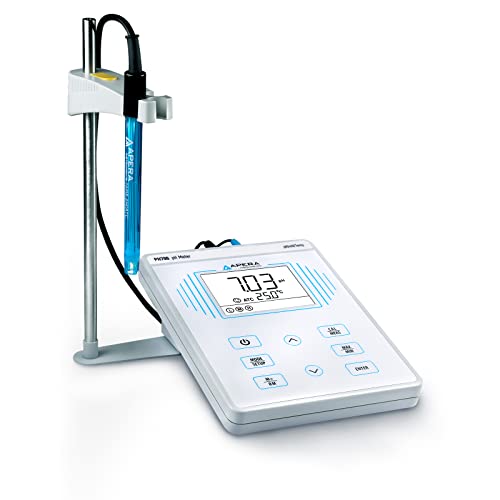
- 0.01 pH accuracy
- 1- to 3-point auto calibration
- 50-set storage and Max/Min readings
Best For: Repeat testing of general water solutions
Best Smart Food Pick
Bluetooth Food pH Meter for Fermentation
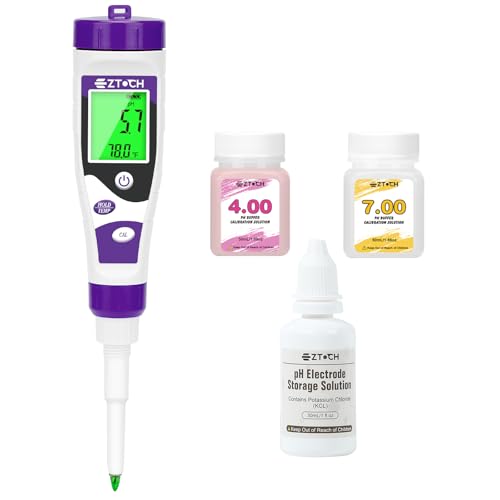
- Built for canning and fermentation
- Bluetooth YINMIK app connectivity
- Stores up to 1,000 readings
Best For: Food processing, baking, and tracked fermentation
Best Portable Value
Apera PH20 Waterproof pH Tester Kit

- ±0.1 pH accuracy
- Waterproof and field-friendly
- Up to 2,000 hours of battery operation
Best For: Portable and outdoor water testing
Best Budget Pick

- ±0.01 pH accuracy and 0.00–14.00 range
- ATC, auto calibration, and backlit LCD
- Compact tester for water and hydroponics
Best For: Everyday liquid testing on a budget
Best Multi-Parameter Pick

- Measures pH, EC, TDS, salinity, and temperature
- Replaceable probe and dual-display LCD
- Complete kit with solutions and carrying case
Best For: Portable multi-metric water testing
Best for Food Testing

- Food-grade Swiss spear electrode
- ±0.01 accuracy and wide pH range
- ATC, alarms, and complete carrying kit
Best For: Food and semi-solid sample testing
Best Premium Pocket Tester – Apera AI311 PH60
The Apera AI311 is a well-equipped choice for shoppers comparing ph meters for regular water-based testing. It combines ±0.01 pH accuracy, a broad -2.00 to 16.00 range, automatic temperature compensation, and a replaceable glass probe in a portable kit.
Best For: Pools, spas, hydroponics, beverages, cooling towers, and environmental monitoring.
Pros:
- ±0.01 pH accuracy with a broad measurement range.
- Automatic calibration recognizes five buffer solutions.
- Backlit LCD shows pH and temperature, with stable-reading and calibration reminders.
- Complete kit includes calibration solutions, storage solution, batteries, and a rugged case.
Cons:
- Requires regular probe care and calibration.
- Automatically powers off after eight minutes without operation.
Choose this model if accuracy, replaceable-probe convenience, and a complete carrying kit matter more than the simplest possible tester.
Best Portable Meter – Milwaukee MW102
The Milwaukee MW102 is a practical pick among ph meters for users who want a larger handheld meter with a separate temperature probe. Its digital LCD, automatic temperature compensation, two-point calibration, and ±0.02 pH accuracy support straightforward routine measurements.
Best For: Buyers who prefer a portable meter with a lab-grade, double-junction electrode and separate temperature probe.
Pros:
- Large digital LCD is easy to read.
- Automatic temperature compensation uses a stainless temperature probe.
- High accuracy of ±0.02 pH across a -2.00 to 16.00 range.
- Included carrying case and battery offer a ready-to-use setup.
Cons:
- Calibration is limited to up to two points.
- The separate probe setup is less compact than a pocket tester.
This is a sensible option for users who value a larger display and lab-style electrode design over an all-in-one pocket format.
Best Value Care Kit – Apera AI209-T PH20
The Apera AI209-T PH20 stands out among ph meters for value-focused shoppers who want maintenance supplies included. It offers automatic buffer recognition, automatic temperature compensation, and a low-impedance sensor designed to improve response and shorten stabilization time.
Best For: Users seeking an affordable tester with organized calibration and probe-care accessories.
Pros:
- Complete calibration and probe-care combo kit is included.
- Probe cleaning brush helps remove contaminants.
- CalBox organizes solutions and can reduce buffer-solution costs.
- Automatic calibration and temperature compensation simplify testing.
Cons:
- The supplied notes do not specify a pH accuracy figure.
- Probe maintenance remains necessary for reliable performance.
Consider the AI209-T when included maintenance accessories and lower ongoing buffer use are priorities in your ph meters comparison.
Best Hydroponic pH Pen – Bluelab pH Pen
The Bluelab pH Pen is a convenient option among ph meters for quick checks in hydroponics and other water-based applications. Its waterproof, floating design, double-junction probe, automatic temperature compensation, and backlit calibration indicator make routine testing simple.
Best For: Hydroponics, growing tents, pools, aquariums, fish tanks, drinking water, and brewing.
Pros:
- Waterproof and floats for added handling convenience.
- Double-junction probe helps minimize contamination and supports longer probe life.
- Two-point calibration and automatic temperature compensation are included.
- Initial kit includes pH 7, pH 4, and KCl sachets.
Cons:
- Readings are measured in 0.1 pH increments, less precise than some competing models.
- Tap, RO, or distilled water may produce slow or unstable readings.
This pen is a strong fit for users who prioritize portability and durable probe design for everyday water and growing-media management.
Best Benchtop Pick – Apera AI501 PH700 Benchtop pH Meter
For buyers who need a more capable setup than handheld ph meters, the Apera AI501 offers 0.01 pH accuracy, automatic temperature compensation, and flexible calibration for general water solutions. Its benchtop design suits repeat testing and organized lab or workshop use.
Best For: General water-solution testing, repeat measurements, and users who want data storage with electrode-condition feedback.
Pros:
- Provides 0.01 pH accuracy with 1- to 3-point automatic calibration.
- Includes a 3-in-1 pH/temperature electrode with automatic temperature compensation.
- Stores up to 50 data sets and offers Max/Min reading mode.
- Includes calibration solutions and a holder for up to two electrodes.
Cons:
- Its benchtop format is less portable than a pocket tester.
- The included electrode is intended for general water solutions rather than a stated food-specific application.
The AI501 is a strong choice among ph meters when precision, calibration flexibility, and convenient benchtop organization matter more than compact size.
Best Smart Food Pick – Bluetooth Food pH Meter for Fermentation
This food-focused option stands out among ph meters for home canning, fermentation, and baking. Bluetooth connectivity, app-based records, and storage for up to 1,000 readings make it useful when you want to track pH values over time rather than take a single spot measurement.
Best For: Home canning, sourdough, brewing, fermented foods, and users who want app-based measurement records.
Pros:
- Designed for foods and beverages including sauces, dairy, beer, wine, kombucha, and fermented products.
- Connects to the YINMIK app through Bluetooth for historical data viewing.
- Can automatically store up to 1,000 readings.
- Includes pH 4.00 and 7.00 calibration solutions, probe storage solution, and a backlit display.
Cons:
- Bluetooth features depend on using the companion app.
- The supplied notes do not specify a numerical accuracy rating.
- Food samples may require careful preparation for consistent readings.
Choose this meter if recordkeeping and food applications are central to your routine; it offers more tracking convenience than a basic, standalone tester.
Best Portable Value – Apera PH20 Waterproof pH Tester Kit
APERA INSTRUMENTS AI209 Value Series PH20 Waterproof pH Tester Kit, ±0.1 pH Accuracy
Check Price On AmazonThe Apera PH20 is one of the more convenient ph meters for portable testing. It combines ±0.1 pH accuracy with automatic calibration, automatic temperature compensation, waterproof construction, and a compact carrying case for field or outdoor use.
Best For: Portable water testing, outdoor use, and buyers who want a straightforward battery-powered tester.
Pros:
- Offers ±0.1 pH accuracy with automatic buffer recognition and calibration.
- Automatic temperature compensation supports readings from 32 to 122°F.
- Waterproof design and included carrying case improve portability.
- Runs for up to 2,000 hours continuously on included AAA batteries.
Cons:
- Its ±0.1 pH accuracy is lower than the AI501’s stated 0.01 pH accuracy.
- The kit includes pH 4 and 7 buffers, but not the broader three-buffer set supplied with the AI501.
- Its approximately five-second response time may feel slow for rapid testing.
The PH20 is a practical value when portability, durability, and simple automatic calibration are more important than laboratory-level precision.
Best Budget Pick – VIVOSUN Digital pH Meter
For straightforward water testing, this VIVOSUN pen-style meter is a practical choice among ph meters. It offers stated ±0.01 pH accuracy, automatic temperature compensation, auto calibration, and a backlit LCD in a compact design.
Best For: Home and commercial testing of hydroponics, aquariums, pools, spas, drinking water, and other liquid samples.
Pros:
- ±0.01 pH accuracy with a 0.00–14.00 range
- Automatic temperature compensation helps account for water temperature
- Compact, lightweight, backlit design with batteries and buffer powders included
- Suitable for varied applications, including hydroponics and aquaculture
Cons:
- Designed for liquid testing rather than specialized solid or semi-solid food samples
- Supplied details do not list a carrying case or replaceable probe
This is a sensible everyday option if you want a compact pH tester with useful convenience features without moving to a multi-parameter instrument.
Best Multi-Parameter Pick – Apera PC60 5-in-1 Tester
If you need more than pH readings, the Apera PC60 stands out among ph meters by combining five measurements in one waterproof pocket tester. It measures pH, conductivity, TDS, salinity, and temperature, with a replaceable probe and kit-focused accessories.
Best For: Users who need portable monitoring of pH plus conductivity, TDS, salinity, and temperature.
Pros:
- Measures five parameters in a single pocket-sized device
- Replaceable multi-parameter probe supports longer-term use
- Large backlit LCD provides dual readings and calibration or stability indicators
- Kit includes calibration solutions, storage solution, batteries, lanyard, and carrying case
Cons:
- More features may be unnecessary if you only need pH readings
- Requires calibration and probe-storage care across multiple measurement functions
The PC60 is the more versatile pick for users managing several water-quality metrics and wanting a complete portable kit rather than a single-purpose tester.
Best for Food Testing – Apera PH60S Food pH Meter
For food and semi-solid samples, the Apera PH60S is a specialized option among ph meters. Its food-grade Swiss spear electrode is designed for products such as cheese, sushi rice, fruit, milk, yogurt, sauces, and skincare products, while still supporting general water testing.
Best For: Testing pH in solid and semi-solid foods, liquids, and other food-related samples.
Pros:
- Food-grade Swiss spear sensor is designed for solid and semi-solid samples
- ±0.01 pH accuracy with a -2.00–16.00 pH range
- Automatic calibration and temperature compensation simplify testing
- Replaceable electrode and complete kit with solutions, batteries, and case
Cons:
- Its specialized food electrode may be unnecessary for basic water-only testing
- Supplied notes do not specify waterproof construction
The PH60S makes the most sense when sample type matters: its spear-style food electrode is the key advantage over general-purpose water pens.
How We Picked These Ph Meters
We focused on meters suited to distinct testing needs, including general water testing, hydroponics, food and fermentation, and laboratory work. Key considerations included stated accuracy, measurement range, replaceable or specialized probes, automatic calibration, waterproof construction, temperature measurement, and included maintenance accessories. Because Ph Meters are only as reliable as their calibration and storage practices, we also favored kits that make routine care easier.
Quick Comparison
Pocket testers are the most convenient choice for quick checks and field use. The Apera PH60 and PH20 models emphasize portable water testing, while the Milwaukee MW102 offers a more traditional portable meter format. The Bluelab pH Pen and VIVOSUN tester are especially relevant to hydroponic users. For broader readings, the Apera PC60 adds EC, TDS, salinity, and temperature measurements. The Apera PH60S is designed for food samples, and the AI501 benchtop meter is the strongest fit for controlled laboratory work.
Key Buying Factors for Ph Meters
Accuracy and Resolution
Choose accuracy based on the task. Routine water and nutrient checks may not require laboratory-level precision, while research, quality control, and tightly controlled recipes benefit from 0.01 pH accuracy. Resolution is not the same as accuracy, so consider both specifications.
Probe Design and Replacement
The probe is a critical wear component. Replaceable probes can extend the life of a meter, and food-specific spear electrodes are better suited to solids, semi-solids, and moist foods than standard water probes. Double-junction designs may provide better resistance to contamination in demanding applications.
Calibration and Maintenance
Automatic one-, two-, or three-point calibration simplifies setup, but every meter still needs suitable buffer solutions, rinsing, and proper storage. Never store a pH electrode dry unless the manufacturer specifically permits it. A maintenance kit or calibration holder can be useful for frequent testing.
Water Resistance and Extra Measurements
Waterproof construction is valuable for fieldwork and hydroponics, but it does not remove the need to clean the probe after use. If you regularly monitor nutrient strength, a multiparameter meter that measures EC, TDS, salinity, and temperature may be more practical than carrying several instruments.
Who Should Buy Which Ph Meters?
For everyday water testing: Choose a compact Apera PH20 or PH60-style pocket tester when portability and straightforward pH readings matter most.
For hydroponics: Consider the Bluelab, VIVOSUN, or Apera PC60. The PC60 is particularly useful when pH is only one part of nutrient management.
For food and fermentation: Select a food-oriented model such as the Apera PH60S, whose spear-style electrode is designed for direct food testing.
For laboratory and quality-control work: The Apera AI501 benchtop meter is the better fit when stable bench operation, higher precision, and multi-point calibration are priorities.
Before buying, confirm that replacement probes, calibration buffers, and storage solution are readily available. Those recurring supplies often determine the long-term value and reliability of your meter more than the initial purchase price.