Small-batch sauce makers need more than a household food mill. The right tomato press can remove skins and seeds quickly, keep production consistent, and reduce hands-on prep during busy preserving or farm-to-market seasons.
This roundup compares 10 electric and clamp-style options across power, throughput, materials, hopper size, and practical workflow needs, so you can choose equipment that matches your daily volume and available space.
Best 10 Tomato Presses for Small Businesses Picks for 2026
Compact Italian Electric Press

- Up to 330 lb/h processing
- Automatic skin and seed separation
- Compact 1/4 HP design
Best For: Small sauce businesses needing a compact 220V electric press
Manual Batch Strainer
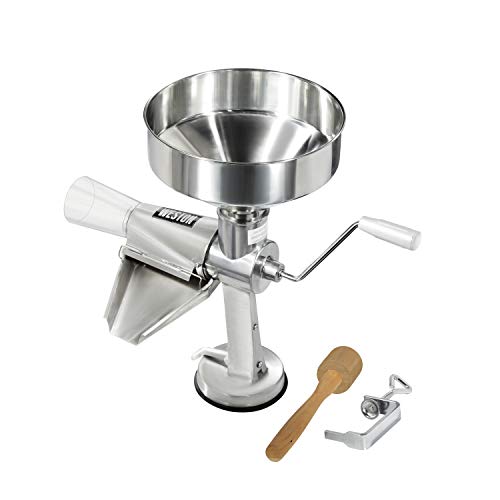
- One-gallon stainless steel hopper
- Dual suction-cup and C-clamp mounting
- Includes 1.5mm screen and stomper
Best For: Manual small-batch sauce and preserve production
High-Output Italian Workhorse

- Up to 772 lb/h stated output
- 650W induction motor with oil-bath gearbox
- Cast iron and AISI 304 stainless steel build
Best For: High-volume sauce and preserve production
Commercial Stainless Steel Mill
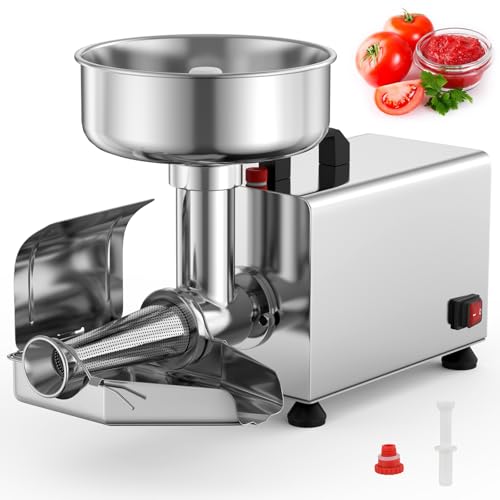
- 200-350 lb/h stated capacity
- 110-120V, 450W full-copper motor
- 304 stainless steel with tool-free disassembly
Best For: Small commercial kitchens processing tomatoes and other fruits
Best Versatility Pick
Johnny Model 250 Electric Tomato Press

- Includes five screen options for varied textures
- Works by hand crank or included electric motor
- Five-year warranty and countertop clamp mount
Best For: Small businesses making sauces, purees, jams, and salsas
Best High-Capacity Pick
ARINOO 450W Commercial Tomato Strainer

- Rated for processing up to 330 pounds per hour
- 304 stainless steel body with enclosed motor housing
- Five-year warranty and lifetime customer support
Best For: Restaurants, farms, and commercial kitchens needing powered throughput
Best Batch-Processing Pick
Weston Deluxe Electric Tomato Strainer

- One-gallon hopper supports larger batches
- Two-speed 250-watt motor includes reverse
- Three stainless steel screens and included stomper
Best For: Businesses making sauces, purees, jellies, and salsa in batches
Heavy-Duty Stainless Steel Pick
370W Commercial Tomato Strainer
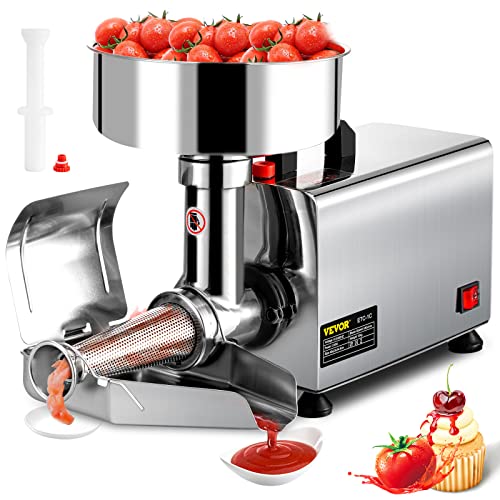
- 304 stainless steel food-contact parts
- 9-inch funnel and adjustable trough
- Low-noise, easy-cleaning design
Best For: Small sauce makers processing tomatoes, berries, and jams
Harvest-Ready Value Pick
VEVOR 370W Electric Tomato Strainer

- Separates peels and seeds in one pass
- Large hopper supports batch processing
- Tool-free disassembly for quick cleaning
Best For: Small kitchens and seasonal batch sauce production
High-Output Production Pick
INTBUYING 450W Tomato Strainer

- 450W motor for higher-throughput work
- Rated for up to 330 pounds per hour
- Stainless steel body with adjustable trough
Best For: Restaurants, cafes, and small producers needing sustained output
Compact Italian Electric Press – OMRA Spremy 850
For small businesses needing dependable tomato presses for small businesses, the OMRA Spremy 850 offers automated straining in a compact electric format. Its 1/4 HP motor separates puree from skins and seeds while handling up to 330 pounds of fresh or cooked tomatoes per hour.
Best For: Small-scale sauce makers prioritizing compact size, automated processing, and Italian construction.
Pros:
- Processes up to 330 pounds of tomatoes per hour.
- Separates puree from seeds and skins automatically.
- Uses a stainless steel hopper, metal housing, and food-grade nylon auger.
- 110 RPM masticating-style operation is designed to preserve enzymes.
Cons:
- Uses 220-volt corded power, which may not suit every workspace.
- Its stated capacity is lower than the highest-output commercial models.
The OMRA is a practical choice when a business wants electric convenience without moving to a larger industrial machine. Confirm that your facility supports 220 volts before purchasing.
Manual Batch Strainer – Weston Metal Tomato Strainer
The Weston Metal Tomato Strainer is a useful option for small businesses looking for tomato presses for small businesses without adding an electric motor. Its one-gallon hopper, smooth-turning handle, and included 1.5mm screen support batch processing of tomatoes, apples, sauces, jams, and purees.
Best For: Small producers who prefer manual control, flexible placement, and lower equipment complexity.
Pros:
- One-gallon stainless steel hopper supports larger manual batches.
- Dual mounting system works with a suction-cup base or C-clamp.
- Removes skins and seeds without peeling or coring first.
- Includes a stomper, splash guard, chute, and 1.5mm multipurpose screen.
Cons:
- Manual operation requires ongoing effort from the operator.
- Additional screens are sold separately.
This Weston model suits businesses processing modest volumes or working in locations without convenient electrical access. Its mounting flexibility is especially useful for kitchen or garden-table production.
High-Output Italian Workhorse – Reber N.5 650W
For businesses handling substantial production, the Reber N.5 is one of the more powerful tomato presses for small businesses in this group. Its 650W induction motor is rated for up to 772 pounds per hour, while the oil-bath gearbox and metal construction are designed for continuous, demanding use.
Best For: High-volume sauce, preserve, jam, and fruit-juice operations that need heavy-duty equipment.
Pros:
- Rated for output up to 772 pounds per hour.
- 650W induction motor supports continuous operation.
- Long Life oil-bath gearbox is designed for quiet, maintenance-free performance.
- Stainless steel AISI 304 processing components and cast-iron body provide a solid build.
Cons:
- Larger 20.5-inch-wide footprint may require dedicated workspace.
- Parts are specified for hand washing rather than dishwasher cleaning.
- Optional attachments are needed for functions such as grinding or pasta pressing.
The Reber N.5 is best viewed as a production-oriented investment rather than a casual kitchen appliance. Its high stated throughput and compatible attachments make it suitable for businesses planning varied or intensive processing.
Commercial Stainless Steel Mill – COSTWAY 450W Strainer
The COSTWAY 450W machine gives small businesses seeking tomato presses for small businesses a commercial-style electric option with a 110-120V power requirement. Its full-copper motor and large 8.5-inch feed chute are rated for 200 to 350 pounds per hour, with tool-free disassembly for easier cleanup.
Best For: Small commercial kitchens wanting electric batch processing, broad fruit versatility, and straightforward maintenance.
Pros:
- Stated processing capacity of 200 to 350 pounds per hour.
- Food-grade 304 stainless steel construction supports commercial use.
- Detachable parts are dishwasher-safe according to the supplied notes.
- Handles tomatoes, strawberries, blueberries, and pineapples.
Cons:
- Product care instructions also specify hand washing, so cleaning guidance should be reviewed carefully.
- At 22 pounds, it is less lightweight than compact countertop presses.
- Its output range may be below the Reber N.5 for the largest workloads.
The COSTWAY balances substantial throughput with familiar 110-120V operation and food-grade stainless steel. It is a strong fit when versatility and cleanup convenience matter as much as tomato processing.
Best Versatility Pick – Johnny Model 250 Electric Tomato Press
For small businesses that need more than a tomato press, the Johnny Model 250 combines hand-crank flexibility with an included electric motor. Its interchangeable screens and sturdy clamp mount make it useful for producing sauces, purees, juices, jams, and other specialty products.
Best For: Small businesses processing varied fruits and vegetables in batches that benefit from multiple texture options.
Pros:
- Includes tomato, berry, pumpkin, salsa, and grape processing components.
- Electric motor can replace the hand crank, offering flexible operation.
- Cast aluminum body, stainless steel screens, BPA-free plastic components, and a five-year warranty.
- Clamp mounts to countertops from 3/4 to 2-1/8 inches thick.
Cons:
- Clamp mounting requires a suitable countertop and setup space.
- Switching between screens and accessories adds preparation time.
This is a practical choice when product variety matters as much as tomato processing. It offers broad functionality and both manual and powered operation, though a dedicated commercial electric unit may be more appropriate for continuous high-volume production.
Best High-Capacity Pick – ARINOO 450W Commercial Tomato Strainer
For small businesses seeking a higher-throughput tomato press, the ARINOO ETC-1C-2 uses a 450-watt copper motor and dual-channel straining design. The stainless steel machine is rated for processing up to 330 pounds per hour, making it suited to restaurants, farms, and commercial kitchens.
Best For: Small businesses that prioritize powered processing capacity and stainless steel construction.
Pros:
- Rated for up to 330 pounds per hour with a 0.6HP pure copper motor.
- Dual-channel design separates skins and seeds without an additional filter.
- Food-grade 304 stainless steel construction is rust-resistant and designed for repeated use.
- Includes a food pusher, enclosed motor housing, detachable parts, five-year warranty, and lifetime support.
Cons:
- Requires a five-minute cooling period after every 15 minutes of continuous use.
- Hand-wash care is specified, which may increase cleanup effort.
- At 20.9 pounds, it is less convenient to move than a compact countertop unit.
The ARINOO stands out for businesses that need a dedicated electric tomato press with substantial stated capacity. Its duty-cycle limitation should be considered when planning uninterrupted production, but the stainless steel build, safety features, and replacement-parts support add practical value.
Best Batch-Processing Pick – Weston Deluxe Electric Tomato Strainer
The Weston Deluxe is a straightforward electric tomato press for small businesses preserving garden harvests or processing produce in bulk. Its one-gallon hopper, two-speed 250-watt motor, and three stainless steel screens support sauces, purees, jellies, salsa, and similar products.
Best For: Small businesses that want a large hopper and simple speed control for regular batch processing.
Pros:
- One-gallon hopper helps accommodate larger batches.
- Two speeds include reverse operation to help prevent jamming.
- Three screens provide 1.5mm, 3mm, and 6mm texture options.
- Includes a stomper for pushing food safely into the hopper.
Cons:
- Its one-year warranty is shorter than the warranties listed for the other featured models.
- The 250-watt motor has less stated power than the 450-watt ARINOO unit.
- The included screen selection may be less specialized than the Johnny Model 250’s accessories.
This Weston model is a balanced option for batch-oriented operations that value a generous hopper and reverse function. It is less focused on maximum stated capacity, but its three screens and uncomplicated controls cover common sauce-making and preserving tasks.
Heavy-Duty Stainless Steel Pick – 370W Commercial Tomato Strainer
For small businesses comparing tomato presses for small businesses, the VBENLEM combines a 370W pure copper motor with food-contact 304 stainless steel parts. Its adjustable discharge trough and 9-inch funnel support steady sauce processing for business kitchens and small-batch production.
Best For: Small sauce makers and food businesses processing tomatoes, berries, and other fruit into sauces or jams.
Pros:
- Food-contact components use 304 stainless steel.
- 370W copper motor is designed for substantial processing work.
- Large 9-inch funnel helps reduce feeding interruptions.
- Disassembles easily and operates with low noise.
Cons:
- At 22 pounds, it may require a dedicated counter space.
- The 110V specification limits use to compatible electrical setups.
The VBENLEM is a practical choice when durable construction, a large feed opening, and flexible sauce discharge matter more than compact storage.
Harvest-Ready Value Pick – VEVOR 370W Electric Tomato Strainer
The VEVOR is a useful option for small businesses seeking tomato presses for small businesses with efficient bulk processing and straightforward cleanup. Its 370W motor, large hopper, and stainless steel filter screen are suited to recurring sauce-making and canning work.
Best For: Small commercial kitchens and seasonal producers handling large batches of tomatoes, puree, juice, or jam.
Pros:
- Filter screen separates peels and seeds in one pass.
- Large hopper helps reduce frequent refilling.
- Core components disassemble without tools for quick rinsing.
- Stainless steel construction helps withstand fruit acids and regular use.
Cons:
- Tomatoes should be cut into smaller pieces to help reduce clogging.
- The 370W motor may be less powerful than higher-wattage alternatives.
Choose this VEVOR model if simplified maintenance and efficient harvest-season processing are priorities for your operation.
High-Output Production Pick – INTBUYING 450W Tomato Strainer
For businesses that prioritize output, the INTBUYING is one of the more powerful tomato presses for small businesses in this selection. Its 450W motor is rated to process up to 330 pounds of ketchup per hour, while the stainless steel body supports repeated commercial and household use.
Best For: Restaurants, cafes, and small producers needing higher-throughput tomato sauce and fruit-puree processing.
Pros:
- 450W motor supports high-volume processing.
- Rated capacity reaches up to 330 pounds of ketchup per hour.
- Food-grade stainless steel construction is durable and easy to clean.
- Adjustable trough and support help direct sauce and reduce splashing.
Cons:
- Its larger footprint may require dedicated workspace.
- It is a 110V machine, so electrical compatibility should be confirmed.
The INTBUYING stands out for small operations that need sustained output and versatility across tomato sauce, berry jams, and fruit purees.
How We Picked the Best Tomato Presses for Small Businesses
We focused on the factors that matter most in a small commercial or serious cottage-food operation: motor power, stated processing capacity, hopper size, stainless-steel construction, durability, ease of cleaning, and the ability to separate skins and seeds efficiently. The selection includes compact electric machines, higher-throughput commercial-style models, and a manual clamp-based option for businesses that process intermittently or want a backup without relying on electricity.
Capacity claims can vary with tomato variety, ripeness, operator technique, and how often the hopper is refilled. Treat advertised pounds-per-hour figures as general comparisons rather than guaranteed production rates.
Quick Comparison
| Best For | What to Prioritize | Suitable Type |
|---|---|---|
| Occasional farm-stand batches | Compact size, simple cleanup, moderate power | Small electric or clamp-style press |
| Weekly sauce production | Stainless construction, continuous feed, reliable motor | 370W–450W electric model |
| High-volume preserving | Large hopper, strong motor, high stated throughput | Commercial-grade electric press |
| Backup or off-grid use | Manual operation, secure mounting, replaceable parts | Clamp-based food strainer |
Key Buying Factors for Tomato Presses for Small Businesses
Capacity and Motor Power
Estimate your largest normal batch, not just your average one. A 370W to 450W machine may suit many small businesses, while a 650W unit or a 1/4 HP motor can be preferable when processing dense, ripe tomatoes for several hours. Higher power does not automatically mean better results, so match it with the manufacturer’s throughput rating and your expected workload.
Construction and Stability
Stainless-steel contact surfaces are easier to sanitize and better suited to frequent use than lightweight plastic components. Also check the base, clamp, or suction support. A press that shifts during operation can slow production and create unnecessary mess.
Cleaning and Maintenance
Look for removable screens, funnels, augers, and splash guards. Confirm that parts can be rinsed promptly after use and that replacement screens or extraction components are available. A slightly slower machine may be the better business purchase if it takes substantially less time to clean.
Electrical and Workspace Requirements
Verify voltage before ordering, particularly when comparing imported commercial machines with domestic models. Measure counter depth and overhead clearance, and leave room for a collection bowl, waste container, and safe access to the controls.
Who Should Buy Which Tomato Presses for Small Businesses?
Choose a compact electric press if you sell modest quantities and value fast setup. Select a heavier stainless-steel commercial-style model if you process multiple batches each week or need more consistent throughput. A higher-powered unit makes sense for peak-season preserving, provided your electrical supply and cleanup routine can support it. Choose the clamp-based Johnny Apple Sauce Maker when low cost, portability, or manual backup matters more than speed.
For most Tomato Presses for Small Businesses, the best choice is the model that balances realistic batch volume, dependable construction, and cleanup time—not simply the one with the highest advertised pounds-per-hour rating.