Making fresh citrus juice for a café, restaurant, event, or busy household requires more than a standard countertop squeezer. The right juicer can improve output, reduce hand fatigue, and make cleanup easier during repeated batches.
We’ve compared 10 electric and manual models across capacity, pressing speed, construction, usability, and maintenance to help you choose a dependable fit for your workload.
Best 10 Citrus Juicers for Large Batches Picks for 2026
High-Output Commercial Pick
VEVOR Commercial Orange Juicer

- Processes up to 20 oranges per minute
- Automatic peeling, juicing, and filtering
- Large commercial stainless-steel design
Best For: High-volume shops, restaurants, and beverage businesses
Durable Manual Press
Can-Can Citrus and Pomegranate Juicer

- Stable clamping system for repeated pressing
- Stainless-steel construction
- Dishwasher-safe and portable
Best For: Hands-on commercial juicing with no outlet required
Compact Bar Workhorse

- Juices up to 120 oranges per hour
- Compact footprint for small counters
- Universal reamer for varied citrus
Best For: Bars and small commercial kitchens
Effortless Motorized Press
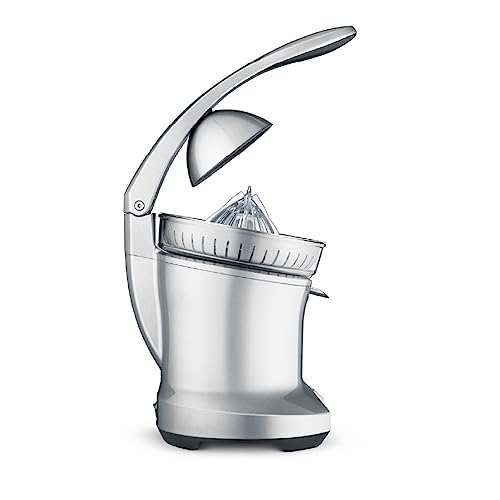
- Handles limes through large grapefruits
- One-handed motorized operation
- Dishwasher-safe removable parts
Best For: Convenient smaller-batch home or office juicing
Commercial Workhorse
Hamilton Beach 932 Manual Citrus Juicer

- Up to 2,000 lb of pressing force
- Acid-resistant metal and enamel construction
- Removable parts and NSF certification
Best For: High-output manual citrus juicing
Powered Convenience
Breville 800CPXL Citrus Press Pro
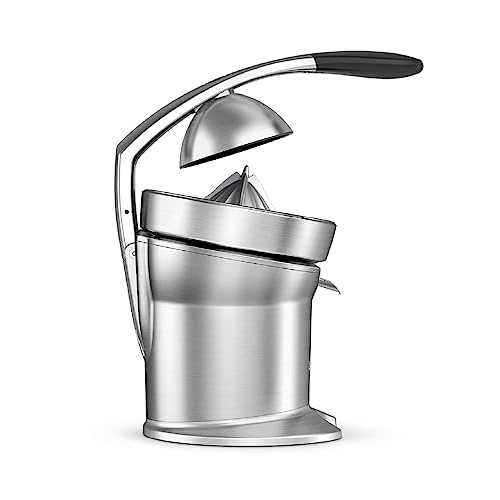
- Power-assisted lever eases repeated pressing
- Acid-resistant Quadra-Fin cone
- Multiple removable parts are dishwasher safe
Best For: Convenient electric batch juicing
Heavy-Duty Manual Press

- Reinforced cast-iron frame
- Long lever and suction base improve control
- Dishwasher-safe removable parts
Best For: Manual citrus and pomegranate pressing
Effortless Electric Pick
Eurolux Premium Electric Orange Juicer

- 120-watt quiet motor for repeated juicing
- Automatic press-and-release operation
- Built-in filter and dishwasher-safe parts
Best For: Convenient home citrus juicing with less manual effort
Commercial Manual Workhorse
ROVSUN Commercial Grade Citrus Juicer

- Heavy-duty cast-iron construction
- Long rubber-grip lever reduces pressing strain
- Works with citrus fruits and pomegranates
Best For: High-volume manual juicing in restaurants, bars, and homes
Heavy-Duty Countertop Press
Eurolux Ultra-Premium Cast Iron Juicer

- Cast-iron frame for continuous manual juicing
- Lever mechanism helps reduce effort
- Stable suction-cup base and stainless steel cup
Best For: Stable countertop pressing of citrus and pomegranates
High-Output Commercial Pick – VEVOR Commercial Orange Juicer
For businesses needing citrus juicers for large batches, the VEVOR Commercial Orange Juicer is built around speed and automation. Its 120W motor and textured juicing wheel can process up to 20 oranges per minute, while the machine handles peeling, juicing, and filtering in one unit.
Best For: Grocery stores, restaurants, fruit shops, bars, beverage shops, and offices that need high-volume citrus processing.
Pros:
- Processes up to 20 oranges per minute.
- Accepts oranges, lemons, grapefruits, and pomegranates measuring 55–80 mm.
- 304 stainless steel and detachable components support thorough cleaning.
- Automatic stop, transparent cover, and water-resistant power switch add practical safety features.
Cons:
- At 81.4 pounds, it is not easy to move frequently.
- Its 16.54-by-25.59-by-30.71-inch footprint requires substantial counter or floor space.
- Hand-wash care may make cleanup more involved than with dishwasher-safe models.
This is the strongest fit when throughput is the priority. The large footprint and commercial weight are trade-offs, but automatic processing and peel collection can streamline busy juice operations.
Durable Manual Press – Can-Can Citrus and Pomegranate Juicer
The Commercial Grade Can-Can Pomegranate and Citrus Juicer takes a manual approach to citrus juicers for large batches. Its clamping system is designed for intensive use, and the pressing principle helps produce juice without requiring excessive force.
Best For: Commercial users who prefer a compact, durable manual press for repeated citrus and pomegranate juicing.
Pros:
- Clamping system helps keep the appliance stable during pressing.
- Manual operation avoids dependence on an electrical outlet.
- Stainless-steel construction is designed for long service life.
- Dishwasher-safe care simplifies cleanup.
Cons:
- Manual pressing is slower and more hands-on than an automatic juicer.
- Its 0.24-liter capacity may require frequent emptying during larger runs.
- It is less suitable when maximum per-minute output is the main goal.
This press suits operators who value durability, stability, and portability over automation. It can handle intensive use, but a powered model may be more efficient for continuous high-volume service.
Compact Bar Workhorse – Waring BJ120C Citrus Juicer
The Waring Compact Electric Citrus Juicer offers a practical middle ground for citrus juicers for large batches when counter space is limited. Its universal reamer handles different citrus fruits and the unit is rated to juice up to 120 oranges per hour.
Best For: Bars, restaurants, and small commercial kitchens that need steady citrus output from a compact machine.
Pros:
- Rated for up to 120 oranges per hour.
- Compact 7.25-by-7.25-by-9.25-inch design suits small work areas.
- Universal reamer juices a variety of citrus fruits.
- Die-cast base and vibration-dampening feet support quiet, stable operation.
Cons:
- Its capacity is lower than the VEVOR machine’s stated 20-oranges-per-minute rate.
- The one-speed design offers limited control over operation.
- The plastic body may feel less heavy-duty than an all-metal commercial machine.
This Waring is a sensible choice when compactness matters as much as throughput. It is better suited to moderate commercial demand than to very large, nonstop production.
Effortless Motorized Press – Breville Citrus Press
The Breville Citrus Press is a convenient option among citrus juicers for large batches when hands-on effort and cleanup are concerns. Its motorized, one-handed operation works with fruit ranging from small limes to large grapefruits, while the one-size-fits-all cone supports consistent pressing.
Best For: Homes, offices, and lower-volume food-service settings seeking an easy-to-use motorized citrus press.
Pros:
- One-size-fits-all cone accommodates limes, lemons, oranges, and grapefruits.
- One-handed operation and a hinged arm reduce pressing effort.
- Drip-stop spout helps limit countertop spills.
- Juicing cone, collector, filter, and fruit dome are dishwasher safe.
Cons:
- Its 110W motor and 1-liter capacity are less geared toward the largest commercial batches.
- The plastic construction may be less robust than stainless-steel commercial equipment.
- Its 17.99-inch height may limit placement beneath low cabinets.
The Breville emphasizes convenience rather than maximum production speed. It is a strong fit for frequent smaller batches, but high-volume commercial users may need a larger-capacity machine.
Commercial Workhorse – Hamilton Beach 932 Manual Citrus Juicer
For citrus juicers for large batches, the Hamilton Beach 932 is a strong manual option built around high pressing force rather than electricity. Its commercial-grade construction, steady Sure Grip feet, and removable strainer and funnel are practical for repeated lemon, lime, orange, or grapefruit juicing.
Best For: Home bars, small food-service settings, and users who want high-output manual pressing.
Pros:
- Up to 2,000 pounds of pressing force helps maximize juice extraction.
- Metal construction and enamel finish resist wear from citrus acids.
- Sure Grip feet help prevent tipping during use.
- Removable stainless steel strainer cone and ABS funnel simplify cleaning.
Cons:
- Hand wash only, so cleanup is less convenient than dishwasher-safe models.
- Its 19.5-inch height may require substantial vertical counter space.
The Hamilton Beach 932 is a durable, food-service-oriented press for users prioritizing extraction and stability. Its manual design avoids motor noise and electrical requirements, though the hand-wash care and tall profile are worth planning for.
Powered Convenience – Breville 800CPXL Citrus Press Pro
Among citrus juicers for large batches, the Breville 800CPXL stands out for its power-assisted lever and electric operation. Its finned cone is designed for different citrus sizes, while the drip-stop spout and dishwasher-safe components make repeated juicing easier to manage.
Best For: Kitchens and entertaining setups that need convenient electric pressing with easier cleanup.
Pros:
- Power-assisted active-arm lever reduces effort during repeated pressing.
- Quadra-Fin acid-resistant cone extracts juice from varied citrus sizes.
- Dishwasher-safe cone, collector, filter, and fruit dome simplify cleanup.
- Drip-stop spout helps reduce countertop spills.
Cons:
- It requires a corded electrical outlet.
- At 10.6 pounds, it is relatively heavy to move and store.
The Breville combines assisted pressing with features tailored to batch work, including a large 800 ml capacity and dishwasher-safe removable parts. It is a practical choice when convenience matters more than a fully manual, electricity-free design.
Heavy-Duty Manual Press – CO-Z Commercial Citrus Juicer
For citrus juicers for large batches without electricity, the CO-Z manual press offers a long lever, cast-iron frame, and nonslip suction base. Its 5-inch funnel accommodates a range of fruit, and the removable strainer is designed to keep seeds and pulp out of the juice.
Best For: Home juice bars, cafes, bars, and restaurants needing a compact manual press for citrus and pomegranates.
Pros:
- Reinforced cast iron is designed to withstand over 2,300 psi.
- Extra-long rubber-grip lever reduces effort with hard fruit.
- Nonslip suction base helps keep the press steady.
- Detachable, dishwasher-safe components support quick cleanup.
Cons:
- Manual operation requires physical effort for extended batches.
- Its 6 kg weight may make frequent repositioning inconvenient.
The CO-Z is a sturdy, versatile manual press with a broad fruit range and a useful 0.8-liter capacity. It suits batch juicing where stability and low-maintenance operation matter, especially when electricity is unavailable or undesirable.
Effortless Electric Pick – Eurolux Premium Electric Orange Juicer
For citrus juicers for large batches, the Eurolux ELCJ-1700 is a practical electric option when you want to reduce manual effort. Its 120-watt motor, soft-grip handle, automatic operation, and one-size-fits-all cone support repeated orange and lemon juicing.
Best For: Home users who want convenient, mostly hands-free citrus juicing with easy cleanup.
Pros:
- Quiet, energy-efficient 120-watt motor with overheat protection
- Press-and-release handle starts and stops the juicing process
- Integrated filter helps separate seeds and unwanted residue
- Dishwasher-safe parts and stainless steel construction
Cons:
- Requires access to a power outlet
- Larger countertop design may take up noticeable space
This model is a strong fit when speed and convenience matter more than manual control. Its automatic operation and built-in filtering make it especially useful for preparing repeated servings with less hand fatigue.
Commercial Manual Workhorse – ROVSUN Commercial Grade Citrus Juicer
Among citrus juicers for large batches, the ROVSUN hand press suits settings that need a sturdy, non-electric solution. Its cast-iron body, long rubber-grip handle, and stainless steel strainer are designed for repeated use with oranges, lemons, limes, grapefruits, and pomegranates.
Best For: Restaurants, bars, parties, families, and other high-volume settings that prefer manual pressing.
Pros:
- Heavy-duty cast-iron construction for commercial-style use
- Long handle with comfortable rubber grip helps reduce hand pressure
- 304 stainless steel strainer and removable funnel simplify cleanup
- Manual pressing avoids rubbing the rind, helping limit bitter flavor
Cons:
- Hand wash only according to the care instructions
- Manual operation still requires repeated physical effort
- At 14.57 inches tall, it may need dedicated storage space
The ROVSUN is a sensible choice for buyers who want durability and control without relying on a motor. Its safety hat, stable commercial-style build, and broad fruit compatibility add practical value for frequent pressing.
Heavy-Duty Countertop Press – Eurolux Ultra-Premium Cast Iron Juicer
For citrus juicers for large batches, the Eurolux ELJ-5004O offers a sturdy manual design built around repeated lever pressing. Its cast-iron frame, stainless steel cup, removable fruit-contact parts, and suction-cup base make it suited to countertop use with citrus and pomegranates.
Best For: Buyers seeking a stable, commercial-grade manual press for fresh juice and recipe preparation.
Pros:
- Heavy-duty cast-iron body supports continuous juicing
- Lever design helps extract juice with less effort
- Removable fruit-contact parts are dishwasher safe
- Suction cups help keep the press secure during use
Cons:
- Manual pressing requires hands-on effort
- The included stainless steel cup holds 15 ounces, so larger batches may require repeated emptying
- Countertop placement is recommended, limiting portability during use
This press stands out for stability and straightforward operation rather than automation. The built-in cup and secure base make it convenient for repeated servings, while the removable parts help keep cleanup manageable.
How We Picked the Best Citrus Juicers for Large Batches
We focused on the features that matter when juicing repeatedly: throughput, pressing effort, motor performance, build quality, stability, ease of cleaning, and compatibility with different fruit sizes. The roundup includes automatic electric machines for speed and manual presses for users who prefer quiet operation, simple mechanics, and strong leverage.
Commercial-oriented construction received extra consideration because stainless steel, cast iron, acid-resistant finishes, and secure bases generally withstand frequent contact with citrus juice better than lightweight household materials. We also considered whether each design suits oranges, lemons, limes, grapefruits, or pomegranates.
Quick Comparison
- Fastest workflow: Electric commercial-style models are the strongest choice when staff need to process fruit continuously.
- Best for quiet operation: Manual lever presses work without motors, making them useful for open kitchens, bars, and occasional power-free use.
- Best for lower effort: Motorized presses reduce repetitive hand and arm strain.
- Best for simple maintenance: Manual models have fewer components, while removable electric parts can make cleanup more manageable.
- Best for varied fruit: Look for a broad cone, adjustable pressing area, or specifications that explicitly support multiple citrus sizes.
Key Buying Factors for Citrus Juicers for Large Batches
Capacity and Throughput
Estimate how much juice you need during your busiest period, not on an average day. Rated outputs such as oranges per hour or per minute are useful benchmarks, but real performance depends on fruit size, ripeness, loading time, and how often the machine needs to be cleaned.
Electric Versus Manual Operation
Electric models are convenient for continuous service and can reduce physical effort, but they require power and may produce more noise. Manual presses are slower for very high volumes, yet their leverage can make repeated pressing surprisingly efficient and their mechanical design is easier to troubleshoot.
Durability and Stability
Choose corrosion-resistant stainless steel or other acid-resistant surfaces where juice will collect. A heavy base, non-slip feet, or secure mounting helps prevent movement while pressing. Cast iron offers substantial leverage and stability, though it may be heavier and require more care around moisture.
Cleaning and Juice Quality
Removable strainers, cones, and collection components simplify sanitation. Check whether parts are dishwasher-safe and whether pulp screens are easy to access. A design that traps pulp in tight seams can slow down service even if its pressing mechanism is powerful.
Who Should Buy Which Citrus Juicers for Large Batches?
Choose a commercial electric model if you run a café, restaurant, juice bar, or event service and need consistent output with minimal manual effort. Choose a premium electric countertop press for a busy home, office, or small service area where convenience matters more than maximum industrial throughput.
Choose a manual lever press if you value quiet operation, durability, and low mechanical complexity. It is particularly suitable for bars, farm stands, occasional commercial use, and users who want control over each pressing cycle. For the heaviest workloads, prioritize the model with the strongest base, largest collection capacity, and easiest cleaning routine rather than choosing solely by advertised speed.