The best tomato presses make sauce preparation faster by separating skins and seeds from cooked tomatoes with far less hand work. The right model depends on your batch size, available storage, and whether you prefer manual control or electric speed.
We compared these 10 tomato presses across capacity, construction, operation, cleanup, and intended use so you can choose a practical fit for everyday cooking or seasonal preserving.
Best 10 Tomato Presses Picks for 2026
Versatile Hand-Crank Pick
Johnny Apple Sauce Maker Model 250

- Includes a 1.3mm apple/tomato screen
- Clamp mounts to countertops 3/4–2-1/8 inches thick
- Compatible with an optional electric motor
Best For: Multi-purpose home sauce and puree making
Classic Batch Strainer
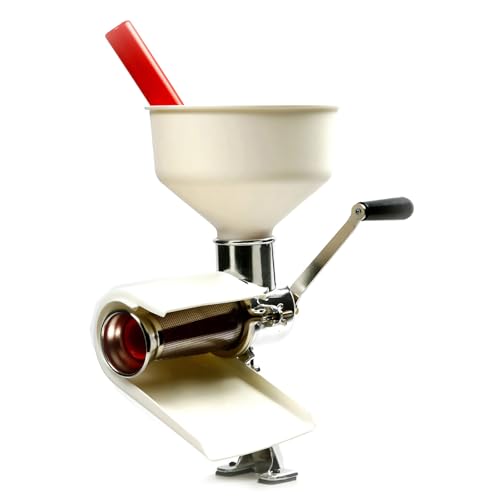
- Has a 3-quart capacity
- Includes a fine mesh screen and standard spiral
- Optional screens support berry, pumpkin, and salsa recipes
Best For: Manual home sauce and puree batches
High-Volume Electric Option
OMRA Spremy Electric Tomato Strainer Model 850

- Processes up to 330 pounds of tomatoes per hour
- Uses a 1/4 HP motor with cooling fan
- Separates puree from skins and seeds automatically
Best For: Large-volume tomato processing with 220V power
Compact Small-Batch Press
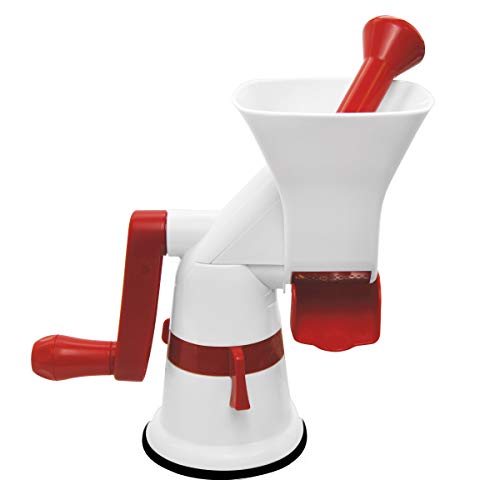
- Has a 3-cup capacity for modest batches
- Includes a stomper and 2mm stainless steel screen
- Auger is designed to reduce jamming and leaking
Best For: Compact manual sauce, jam, and juice preparation
Simple Manual Pick

- Manual mill strains tomatoes without peeling or coring.
- Suction base helps secure the unit during use.
- Includes stainless steel pusher; plastic construction.
Best For: Small-batch sauces, salsa, and tomato purees
Electric Batch Choice
Weston Deluxe Electric Tomato Strainer

- 250-watt motor offers forward and reverse speeds.
- One-gallon hopper suits larger processing batches.
- Three stainless steel screens support varied textures.
Best For: Harvest processing, canning, sauces, and salsa
Durable Manual Design
Weston Stainless Steel Tomato Strainer
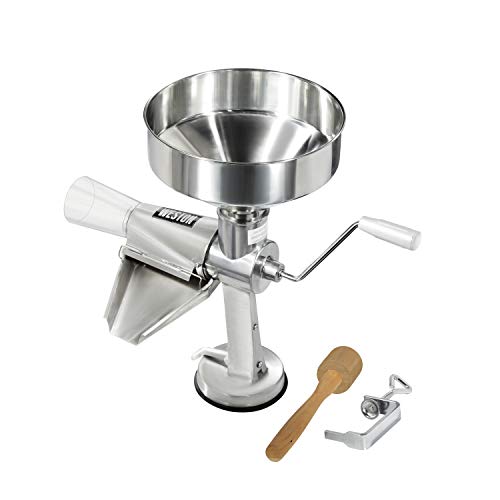
- Stainless steel construction with a one-gallon hopper.
- Dual mount uses a suction base or C-clamp.
- Includes stomper and 1.5mm screen; extra screens sold separately.
Best For: Large manual batches and flexible kitchen or garden use
Best Manual Tomato Press
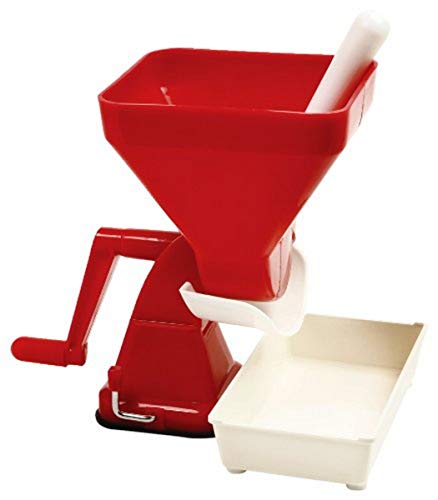
- Stainless mesh separates seeds and skins
- Secure suction base for smooth counters
- 2.25-quart hopper for home batches
Best For: Manual home canning and applesauce
Best High-Capacity Tomato Press
ARINOO Electric Tomato Strainer

- 450-watt copper motor
- Rated up to 330 pounds per hour
- Automatic seed and skin separation
Best For: Large-batch home or commercial processing
Best Commercial Tomato Press
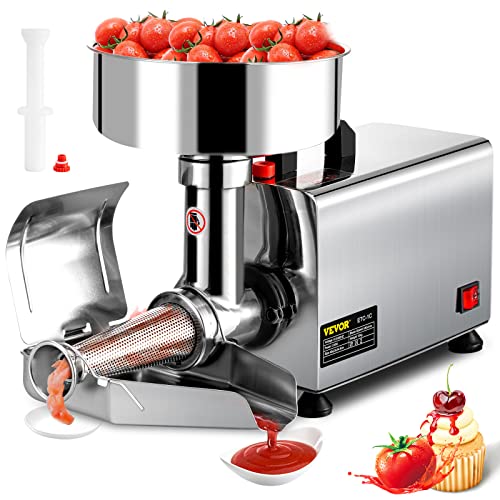
- 370-watt pure copper motor
- 9-inch feeding funnel
- Adjustable trough for smoother discharge
Best For: High-volume sauce and jam milling
Versatile Hand-Crank Pick – Johnny Apple Sauce Maker Model 250
For shoppers comparing tomato presses, the Johnny Apple Sauce Maker is a versatile clamp-mounted option that separates skins and seeds with its included 1.3mm apple/tomato screen. Its hand crank, optional motor compatibility, and broad produce applications make it useful beyond tomato sauce.
Best For: Home cooks who want a multi-purpose strainer for sauces, purees, juices, jams, and baby food.
Pros:
- Includes an apple/tomato screen, standard spiral, and instructions.
- Handles fruits and vegetables, including sauces, purees, and juices.
- Clamp mounts to countertops from 3/4 to 2-1/8 inches thick.
- Includes a stated five-year warranty and BPA-free plastic components.
Cons:
- The electric motor is optional and sold separately.
- Additional screens for salsa, pumpkin, and berries cost extra.
- Clamp mounting requires a suitable countertop edge.
This is a strong all-around choice if you value flexibility and manual control. The included tomato screen gets you started, while optional accessories expand its uses.
Classic Batch Strainer – Norpro 1951 Sauce Master
The Norpro 1951 Sauce Master is a practical tomato press for separating juice and pulp from produce in one operation. Its 3-quart capacity and included fine mesh screen suit routine home sauce and puree preparation.
Best For: Cooks who want a straightforward manual strainer for vegetables, fruits, and purees.
Pros:
- Offers a 3-quart, or 95-ounce, capacity.
- Automatically separates juice and pulp through a chrome-plated steel screen.
- Includes a fine mesh screen, standard spiral, recipe, and instruction booklet.
- Optional berry, pumpkin, and salsa screens are available.
Cons:
- Additional specialty screens are sold separately.
- It is specified for hand washing only.
- The supplied information does not indicate electric operation.
With its relatively generous capacity and basic included setup, the Sauce Master is suited to recurring small-to-medium home batches. It is best for buyers who prefer a simple manual workflow.
High-Volume Electric Option – OMRA Spremy Electric Tomato Strainer Model 850
Among tomato presses, the OMRA Spremy stands out for electric, high-volume processing. Its 1/4 HP motor and stainless steel hopper are designed to extract tomato puree while separating skins and seeds from fresh or cooked tomatoes.
Best For: Users processing large quantities of tomatoes who want powered operation instead of hand cranking.
Pros:
- Rated for production of up to 330 pounds, or 150 kilograms, of tomatoes per hour.
- Automatically separates puree from seeds and skins.
- Uses a die-cast metal housing and stainless steel hopper.
- Food-grade nylon auger rotates at 110 RPM, with a motor cooling fan.
Cons:
- Requires corded electric power.
- The listed voltage is 220 volts, which may limit compatibility.
- Its high-volume design may be more than needed for occasional small batches.
This is the most production-oriented option in the group. Verify your electrical setup before buying, but for substantial tomato processing, its powered extraction and stated throughput are significant advantages.
Compact Small-Batch Press – Weston Fruit & Tomato Press
The Weston Fruit & Tomato Press is a compact manual choice for shoppers comparing tomato presses for smaller recipes. Its 3-cup capacity, stainless steel screen, and included stomper are aimed at making modest batches of sauces, juices, jams, and baby food.
Best For: Home cooks making small batches who want a compact, manually operated press.
Pros:
- Compact 3-cup capacity suits small quantities.
- Separates seeds and skins as the handle turns.
- Its auger is designed to help prevent jamming and leaking.
- Includes a stomper and stainless steel screen with 2mm holes.
Cons:
- The 3-cup capacity is limited for larger processing jobs.
- Manual winding requires hands-on operation.
- The supplied information does not mention interchangeable screens.
This Weston model makes sense when storage space and batch size matter more than speed. It offers the essential separating function in a smaller manual format.
Simple Manual Pick – Tomato Strainer Food Mill
This manual option is a practical choice among tomato presses for cooks who want to strain, juice, or puree tomatoes without peeling, deseeding, or coring them first. Its suction-cup base helps keep the food mill in place during use.
Best For: Small-batch homemade sauces, salsa, and tomato purees.
Pros:
- Separates skins and seeds while directing juice into the tray.
- Includes a stainless steel pusher for guiding tomatoes through the mill.
- Suction mount provides a stable setup on suitable surfaces.
- Useful for straining, juicing, and pureeing tomatoes.
Cons:
- Manual operation requires turning the press by hand.
- Plastic construction may be less substantial than an all-metal model.
- Only a suction-cup mounting system is listed.
Choose this food mill if you value straightforward operation and easy cleanup over electric processing or large-batch capacity. It is especially suited to garden-fresh ingredients and everyday kitchen preparation.
Electric Batch Choice – Weston Deluxe Electric Tomato Strainer
For larger harvests, this electric model stands out among tomato presses with a 250-watt motor, a one-gallon hopper, and forward and reverse speeds. It is designed to remove skins and separate seeds for sauces, purees, jellies, and salsa.
Best For: Garden harvests, bulk produce, and canning preparation.
Pros:
- 250-watt motor provides electric processing with two speeds.
- Reverse speed helps prevent jamming.
- One-gallon hopper supports larger batches.
- Includes 1.5mm, 3mm, and 6mm stainless steel screens for different textures.
Cons:
- Requires access to a 120-volt AC power source.
- Larger 14-by-12-by-17-inch footprint needs substantial counter or table space.
- Electric components add complexity compared with a manual press.
This Weston is the stronger fit when speed and batch capacity matter. The interchangeable screens also make it more versatile for smooth tomato processing, larger vegetable purees, and chunkier salsa.
Durable Manual Design – Weston Stainless Steel Tomato Strainer
This stainless steel model is a sturdy manual choice among tomato presses, combining a one-gallon hopper with a dual-mount system. It separates skins and seeds without requiring peeling or coring, while its chute directs puree into a container, jar, or bag.
Best For: Large manual batches and users who want flexible mounting.
Pros:
- Stainless steel hopper, handle, splash guard, and chute provide a durable setup.
- Dual mounting uses either a suction-cup base or C-clamp.
- One-gallon hopper accommodates larger quantities of produce.
- Includes a stomper and 1.5mm screen for tomatoes and apples.
Cons:
- Manual turning requires more hands-on effort than an electric press.
- Only the 1.5mm screen is included; additional screens are sold separately.
- A secure flat mounting surface is needed for use.
This Weston makes sense for shoppers who prefer manual control but still want a metal build and substantial hopper. Its suction-and-clamp mounting options make it adaptable for kitchen counters or suitable garden tables.
Best Manual Tomato Press – Norpro Jumbo Sauce Maker
The Norpro Manual Jumbo Tomato Strainer & Sauce Maker is a practical choice among tomato presses for home canning and smaller batches. Its stainless steel mesh separates seeds, skins, and stems while the suction base helps keep the unit steady during hand-cranking.
Best For: Home cooks who want a manual press for tomato sauce, puree, juice, paste, salsa, or applesauce.
Pros:
- Stainless steel mesh automatically separates seeds, skins, and stems.
- Strong suction base helps secure the press to smooth countertops.
- Large 2.25-quart hopper and included receiving tray support batch processing.
- Includes a pestle, instructions, and starter recipes.
Cons:
- Manual cranking requires more effort than an electric machine.
- The suction base is designed for smooth surfaces.
- Its 1.25-quart receiving tray may require emptying during larger batches.
Choose this Norpro if you value simple operation and compact home-canning versatility over powered throughput. It also handles cooked apples, making it useful beyond tomato season.
Best High-Capacity Tomato Press – ARINOO Electric Tomato Strainer
For buyers comparing tomato presses for frequent or high-volume use, this ARINOO electric tomato strainer emphasizes speed and automated separation. Its 450-watt copper motor and dual-channel design are intended to produce smooth puree without an extra filtering step.
Best For: Home canners, restaurants, farms, and commercial kitchens processing large quantities of tomatoes and fruit.
Pros:
- Electric 450-watt motor is rated for processing up to 330 pounds per hour.
- Dual-channel design separates seeds and skins automatically.
- Food-contact components use food-grade 304 stainless steel.
- Includes a safety guard, food pusher, detachable parts, and a five-year warranty.
Cons:
- At 20.9 pounds, it is substantially heavier than a manual press.
- Requires a 110V electrical outlet.
- Continuous operation should be limited to 15 minutes followed by a five-minute cooldown.
This model makes the most sense when throughput is more important than portability. The electric drive and generous stated capacity suit large batches, while the detachable construction supports cleanup after processing.
Best Commercial Tomato Press – VBENLEM Electric Tomato Mill
The VBENLEM 110V Electric Tomato Strainer is one of the more commercial-oriented tomato presses in this group. It combines a 370-watt pure copper motor with stainless steel food-contact parts, a wide funnel, and an adjustable discharge trough for sauce and jam production.
Best For: Users who need an electric machine for tomatoes, ketchup, fruit sauces, or jams and want a large feed opening.
Pros:
- 370-watt pure copper motor supports high-volume milling.
- 304 stainless steel food-contact parts are easy to disassemble and clean.
- 9-inch funnel allows substantial fruit loading.
- Adjustable trough and brace help direct sauce and reduce splashing.
Cons:
- Weighs 22 pounds, so it is not especially portable.
- Requires a 110V power source.
- Its commercial design may be more machine than occasional users need.
Consider the VBENLEM when a wide hopper and durable electric construction are priorities. Its adjustable outlet is particularly useful for directing sauce during repeated milling sessions.
How We Picked the Best Tomato Presses
We focused on the features that matter when processing fresh tomatoes: separation performance, throughput, hopper and bowl capacity, stability, durability, and cleanup. The selection includes compact clamp-on and manual models, countertop electric machines, and higher-capacity stainless-steel options. Because these presses serve different cooking styles, we considered both occasional home use and larger preserving sessions rather than treating maximum output as the only measure of quality.
We also looked for useful differences in construction and operation, including metal versus plastic components, included screens or strainers, motor power, mounting style, and how easily parts can be removed for washing. Product specifications can vary by seller, so confirm the current dimensions, voltage, accessories, and capacity before ordering.
Quick Comparison
| Type | Best For | Main Advantage | Trade-Off |
|---|---|---|---|
| Manual clamp-on | Small batches and occasional use | Low cost and simple storage | Requires hand cranking |
| Manual hopper-style | Home canning and repeated batches | More control without electricity | Slower and more labor-intensive |
| Compact electric | Regular sauce making | Faster processing with less effort | Needs counter space and power |
| Commercial-style electric | Large harvests and frequent use | High throughput and sturdy construction | Higher price and larger footprint |
Key Buying Factors for Tomato Presses
Capacity and Output
Choose a compact press for a few jars or small meal-prep batches. If you process garden harvests, prioritize a larger hopper, continuous-feed design, and higher hourly output. Capacity claims may describe the hopper, finished juice, or theoretical processing rate, so compare specifications carefully.
Manual Versus Electric Operation
Manual presses are quiet, portable, and easy to use away from an outlet, but they require steady cranking. Electric Tomato Presses reduce physical effort and are especially useful for repeated batches. Check motor wattage, duty-cycle guidance, voltage, and whether the machine can handle your expected workload.
Materials, Stability, and Cleanup
Stainless steel and reinforced metal components generally suit frequent use, while lighter plastic parts can be convenient for occasional cooks. A secure clamp or stable base prevents tipping. Removable screens, augers, and funnels make cleanup easier, but verify which parts are dishwasher-safe and whether replacement screens are available.
Separation and Adjustability
Look for a screen designed to remove tomato skins and seeds efficiently. Adjustable pressure or multiple screens can help when working with softer produce, grapes, berries, or other ingredients, but confirm that the accessory set matches your intended recipes.
Who Should Buy Which Tomato Presses?
Choose a basic manual press if you make occasional sauce, have limited storage, or want the simplest low-cost setup. Choose a larger manual model for seasonal canning when you value control and do not mind hand operation. Choose a compact electric press if you prepare sauce regularly and want to reduce cranking time without moving to commercial equipment. Choose a heavy-duty electric model when you process large garden harvests, need faster throughput, or expect frequent use. Whichever style you select, measure your counter and storage space first, and pair the press with a suitable collection bowl and straining screen.