Reliable pH testing helps professional kitchens verify recipes, monitor fermentation, and support safe canning and preservation. The right meter should deliver repeatable readings while standing up to frequent food contact and cleaning.
We selected 10 food-focused pH meters ranging from straightforward budget testers to precision models with replaceable probes, automatic temperature compensation, and waterproof designs.
Best 10 Ph Meters for Professional Kitchens Picks for 2026
Best Food-Sample Precision

- Food-grade replaceable Swiss spear sensor
- ±0.01 pH accuracy with auto calibration and ATC
- Includes solutions, storage supplies, and carrying case
Best For: Professional food testing across solid, semi-solid, and liquid samples
Best for Logged Fermentation Work
- Saves readings through the YINMIK app
- Stores up to 1,000 data points
- Includes calibration and probe protection solutions
Best For: Canning, fermentation, brewing, and documented kitchen processes
Best General-Purpose Water Tester

- ±0.01 pH accuracy across a wide range
- Auto calibration and temperature compensation
- Replaceable glass probe with complete kit
Best For: Liquid samples, beverages, water solutions, and process checks
Best Value Spear-Probe Option
GIDIGI Food Fermentation pH Meter
- Spear probe handles semi-solid food samples
- Detachable probe supports longer-term use
- Water-resistant body and included calibration solutions
Best For: Fermentation, canning, sauces, dairy, meat, and cheese testing
Reliable Everyday Pick
Apera PH20 Waterproof pH Tester

- Automatic calibration and temperature compensation
- Waterproof body with carrying case and buffers
- Up to 2,000 hours of battery operation
Best For: Routine kitchen and food-service pH checks
Food-Focused Choice
GIDIGI Spear Probe Food pH Meter

- Spear probe suits dough, meat, and cheese
- 0.01 pH readings with automatic temperature compensation
- Replaceable probe and three buffer solutions included
Best For: Fermentation and semi-solid food testing
Precision Water-Testing Option

- ±0.01 pH accuracy with temperature measurement
- IP67-rated protection for moisture and dust
- Replaceable probe and complete calibration solutions
Best For: Liquid testing, brewing, and water-quality monitoring
Best Overall

- Spear probe tests solids, semi-solids, and liquids
- Includes three calibration solutions
- Backlit display with ATC and 0–14 range
Best For: Versatile fermentation, canning, and food-acidity testing
Best for Long-Term Use

- Includes an extra replaceable pH probe
- ATC supports temperature-variable testing
- KCL-moistened cap helps maintain probe moisture
Best For: Frequent food testing where probe replacement matters
Best Value

- States ±0.1 accuracy across a 0.00–14.00 range
- Three-point auto-calibration
- Includes six bags of buffer-solution powder
Best For: Broad food, fermentation, and canning applications
Best Food-Sample Precision – Apera PH60S Food pH Meter
For professional kitchens seeking ph meters for professional kitchens, the Apera PH60S is designed around food testing. Its replaceable Swiss spear electrode can penetrate solid and semi-solid samples, while automatic calibration and temperature compensation simplify routine checks.
Best For: Testing cheese, sushi rice, fruit, dairy, sauces, and other solid or semi-solid foods.
Pros:
- Food-grade, replaceable Swiss spear sensor suits a wide range of food samples.
- ±0.01 pH accuracy, automatic calibration, and automatic temperature compensation.
- High/low alarms and a three-color backlit LCD make readings easier to monitor.
- Includes calibration solutions, storage solution, batteries, bottles, lanyard, and carrying case.
Cons:
- The feature-rich kit may be more than needed for occasional basic water testing.
- The product is designed for food and general water solutions, not described as waterproof.
The PH60S is a strong choice when a kitchen needs repeatable measurements across both liquid and textured foods, with useful alerts and a complete maintenance kit included.
Best for Logged Fermentation Work – Bluetooth Food pH Meter
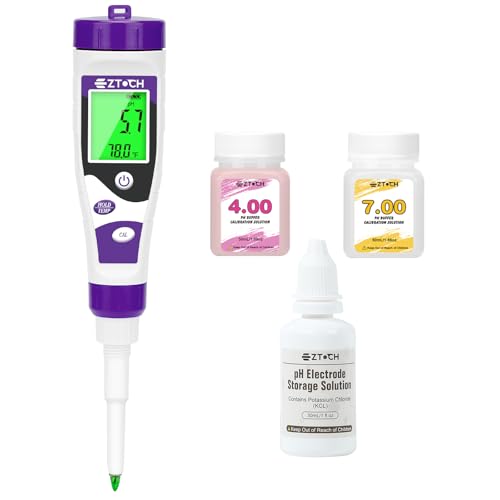
Among ph meters for professional kitchens, this Bluetooth food pH meter stands out for record keeping. It connects to the YINMIK app, automatically stores up to 1,000 readings, and supports food, fermentation, brewing, and canning applications.
Best For: Kitchens that need to document pH readings for canning, sourdough, sauces, dairy, kombucha, or brewing.
Pros:
- Bluetooth connectivity allows readings and historical data to be saved in the YINMIK app.
- Automatic storage can retain up to 1,000 data points.
- Broad application range includes canning, fermentation, brewing, dairy, sauces, and pickles.
- Includes pH 4.00 and 7.00 calibration solutions plus probe protection solution.
Cons:
- App-based features may be unnecessary for kitchens that only need immediate readings.
- The supplied notes do not specify a measurement accuracy figure.
- Bluetooth functionality adds an additional setup step compared with a standalone meter.
This is the most practical option for teams that value traceability and historical records, especially when monitoring recurring fermentation or canning processes.
Best General-Purpose Water Tester – Apera PH60 Pocket Tester
For kitchens that need ph meters for professional kitchens but primarily test liquids, the Apera PH60 offers a replaceable glass probe and a wide -2.00 to 16.00 pH range. Automatic temperature compensation, multi-point calibration, and a stable-reading indicator support consistent operation.
Best For: Testing water solutions, beverages, pools, hydroponics, and other liquid samples.
Pros:
- ±0.01 pH accuracy with a -2.00 to 16.00 pH measurement range.
- Supports one- to three-point automatic calibration and recognizes five solution types.
- Automatic temperature compensation covers 32–122°F.
- Replaceable probe and included calibration, storage, and carrying accessories improve serviceability.
Cons:
- The standard glass probe is intended for regular water solutions rather than spear-style food penetration.
- Automatic power-off after eight minutes may interrupt longer workflows.
- The listed applications focus more on liquids and water solutions than solid foods.
The PH60 is a sensible fit for beverage stations, water checks, and liquid-process monitoring where precision and a replaceable probe matter more than direct testing of dense foods.
Best Value Spear-Probe Option – GIDIGI Food Fermentation pH Meter
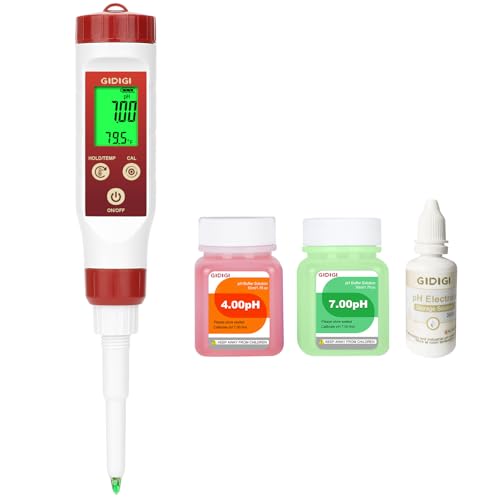
For buyers comparing ph meters for professional kitchens on value and versatility, the GIDIGI food fermentation meter combines a spear-shaped probe with a 0–14 pH range. Its detachable sensor is suited to semi-solid foods, while the water-resistant body is practical for wet kitchen environments.
Best For: Fermentation, canning, sauces, dairy, meat, cheese, bread, and other mixed food samples.
Pros:
- Spear-tip probe penetrates semi-solid foods such as cheese, meat, and bread.
- Detachable probe can extend service life and reduce replacement cost.
- Includes pH 4.00 and 7.00 calibration solutions plus electrode protection solution.
- Water-resistant construction supports use and cleanup in wet kitchen settings.
Cons:
- The supplied notes do not state a specific accuracy rating.
- Alkaline measurements may require separately sourced pH 10.01 calibration solution.
- The 0–14 range is narrower than the range offered by the Apera meters in this roundup.
The GIDIGI offers a practical feature set for kitchens testing both liquids and textured foods, particularly when a detachable spear probe and included starter solutions are priorities.
Reliable Everyday Pick – Apera PH20 Waterproof pH Tester
APERA INSTRUMENTS AI209 Value Series PH20 Waterproof pH Tester Kit, ±0.1 pH Accuracy
Check Price On AmazonFor professional kitchens seeking dependable ph meters for professional kitchens, the Apera PH20 offers straightforward digital testing with ±0.1 pH accuracy. Automatic buffer recognition, automatic temperature compensation, and stable-value recognition help make routine checks more consistent.
Best For: General kitchen and food-service pH checks where simple operation, portability, and long battery life matter.
Pros:
- Automatic calibration with buffer recognition simplifies setup.
- ATC supports readings across 32°F to 122°F.
- Waterproof design and included carrying case improve everyday portability.
- Up to 2,000 hours of continuous operation from included AAA batteries.
Cons:
- Its ±0.1 pH accuracy is less precise than the ±0.01 models in this roundup.
- The standard probe is not specifically described as a spear probe for semi-solid foods.
The PH20 is a practical, low-maintenance choice for teams that value easy calibration and extended battery life over laboratory-level resolution.
Food-Focused Choice – GIDIGI Spear Probe Food pH Meter
Among ph meters for professional kitchens, this GIDIGI model stands out for food preparation and fermentation. Its replaceable spear probe is designed for semi-solid samples such as dough, meat, and cheese, while ATC covers samples from 32°F to 140°F.
Best For: Fermentation, cheesemaking, sourdough, cured meats, canning, kombucha, wine, and other applications involving textured food samples.
Pros:
- 0.01 pH resolution with automatic temperature compensation.
- Spear tip probe penetrates dough, meat, and cheese.
- Replaceable electrode can extend the meter’s usable life.
- Includes pH 4.00, 7.00, and 10.01 buffers, a carrying case, and a backlit display.
Cons:
- Its stated 30-second reading time may be slower than meters designed for faster liquid checks.
- The product’s broad feature set may be more than needed for basic water testing.
For professional kitchens working with ferments and semi-solid foods, the spear probe and replaceable electrode make this a particularly purpose-built option.
Precision Water-Testing Option – AC Infinity pH Meter PRO
For kitchens that also monitor brewing or other liquid systems, the AC Infinity PRO is one of the more precise ph meters for professional kitchens. It provides ±0.01 pH accuracy, temperature measurement, an IP67-rated housing, and a replaceable sensor probe.
Best For: Liquid-focused kitchen testing, homebrewing, and operations that want a durable meter with replaceable sensing hardware.
Pros:
- ±0.01 pH accuracy supports precise readings.
- Replaceable probe helps reduce replacement costs when the sensor wears out.
- IP67-rated construction is sealed against high-volume moisture, dust, and sand.
- Includes KCL and pH 4.00, 7.00, and 10.01 calibration solutions.
Cons:
- It is primarily described for water-quality applications rather than solid or semi-solid foods.
- The supplied notes do not specify a food-specific spear probe.
This is a strong fit when precision liquid measurement and probe replaceability are priorities, especially for brewing and other water-based kitchen processes.
Best Overall – GIDIGI Food pH Meter
For professional kitchens that need one versatile tool for fermentation, canning, and ingredient checks, this GIDIGI model is among the more adaptable ph meters for professional kitchens. Its spear probe is designed for liquids, semi-solids, emulsions, meat, sauces, and dairy, while ATC helps maintain consistent readings across changing temperatures.
Best For: Commercial or serious home kitchens testing sourdough, fermented foods, sauces, meat, dairy, and canned foods.
Pros:
- Spear-tip probe handles solids, semi-solids, liquids, and emulsions.
- Includes 4.00, 7.00, and 10.01 calibration solutions.
- Backlit color display and separate temperature sensor support easy reading and stable performance.
- Wide 0–14 pH range suits varied food-testing tasks.
Cons:
- At 1.17 pounds, it is heavier than a compact handheld tester.
- AAA batteries are required for operation.
The combination of a food-focused spear probe, calibration supplies, and readable display makes this a practical all-around choice when a kitchen needs to move between fermentation, preservation, and routine acidity checks.
Best for Long-Term Use – YINMIK Meter with Spare Probe
For professional kitchens where probe damage or downtime is a concern, this YINMIK is a practical option among ph meters for professional kitchens. It includes an extra replaceable pH probe, plus ATC and a KCL-moistened protective cap to support stable readings and longer probe life.
Best For: Busy kitchens and food producers that regularly test sourdough, meat, sauces, cheese, jams, and other fermented foods.
Pros:
- Includes a second replaceable calibration probe.
- Spear probe is suitable for sourdough dough and meat samples.
- ATC supports readings across different temperatures.
- Protective cap includes a KCL-soaked sponge to help keep the probe moist.
Cons:
- The supplied notes do not specify included calibration solutions or accuracy.
- Its 0–14 range is broad, but the product is primarily described for food applications.
The spare probe is the main differentiator: it can reduce interruption if the original probe is damaged, making this a sensible pick for frequent on-site and production-line testing.
Best Value – YINMIK Food pH Tester
This YINMIK food tester offers useful features for professional kitchens seeking ph meters for professional kitchens without a complicated setup. It combines a spear probe, 0.00–14.00 pH range, stated ±0.1 accuracy, ATC, and three-point calibration for food, fermentation, canning, and cosmetic samples.
Best For: Kitchens that want a compact, broadly useful tester for sourdough, fermented sauces, canned foods, meat, and similar samples.
Pros:
- Stated ±0.1 accuracy across a 0.00–14.00 pH range.
- Spear probe can test dough, food, cosmetics, and lotions without making slurries.
- Three-point auto-calibration supports setup across the meter’s range.
- Includes six bags of buffer-solution powder.
Cons:
- Buffer powder must be prepared for calibration.
- The supplied notes do not mention a spare probe.
With its stated accuracy, broad range, and included calibration powder, this model is a well-rounded choice for kitchens that need regular acidity checks across multiple food processes.
How We Picked the Best Ph Meters for Professional Kitchens
We focused on meters suited to culinary work rather than general aquarium or hydroponic testing. Selection factors included stated accuracy, measurement range, food-friendly probe designs, calibration support, waterproofing, display readability, and the availability of replacement electrodes. We also considered whether each model is practical for repeated checks involving sauces, fermented foods, dough, meat, and canning mixtures.
Accuracy specifications are useful, but proper calibration and cleaning have a major effect on real-world results. A meter with a replaceable probe can be a better long-term investment for a busy kitchen, even if its initial price is higher.
Quick Comparison
| Feature | What to look for | Why it matters |
|---|---|---|
| Accuracy | About ±0.01 pH for precision work; ±0.1 pH for basic checks | Determines how closely readings track the actual sample |
| Probe design | Food-grade spear or piercing electrode | Works better with semi-solid foods and dense mixtures |
| Calibration | One-, two-, or three-point calibration | Supports dependable readings across different pH ranges |
| Maintenance | Replaceable probe and proper storage solution | Extends service life and helps preserve sensor performance |
| Protection | Water-resistant or waterproof housing | Reduces risk from splashes and routine kitchen handling |
Key Buying Factors for Ph Meters for Professional Kitchens
Accuracy and Calibration
Choose the accuracy level based on the job. Fermentation monitoring and food-safety decisions generally benefit from a precision meter, while rough recipe checks may not require the same specification. Confirm that calibration solutions are included or readily available, and follow the manufacturer’s schedule.
Probe Shape and Food Compatibility
A spear-style probe is useful for foods that are thick, soft, or semi-solid, including sourdough, salsa, cheese mixtures, and meat. Confirm that the electrode is intended for food testing and can be cleaned without damaging the sensing tip. Never force a probe into a hard sample.
Temperature Compensation and Range
Temperature can influence pH readings. Automatic temperature compensation, often abbreviated ATC, can improve consistency when samples are tested at different temperatures, but it does not replace cooling samples or following a validated procedure. A broad pH range is useful when one meter will handle both acidic preserves and near-neutral foods.
Durability and Upkeep
For commercial use, look for a sealed housing, a readable LCD, and a replaceable sensor. Rinse the probe after each use, avoid cross-contamination between samples, store the electrode as directed, and never let a refillable or glass sensing tip dry out unless the manual specifically permits it.
Who Should Buy Which Ph Meters for Professional Kitchens?
Choose a precision food meter if your kitchen regularly tests canned foods, fermented products, sauces, or recipes where small pH changes matter. The Apera food-focused model with a Swiss spear electrode is especially suited to demanding sample types.
Choose a waterproof pocket tester for frequent day-to-day checks and easy cleanup. Models with replaceable probes offer better long-term value for professional kitchens than sealed, disposable-style units.
Choose a basic digital food meter if you need an affordable way to monitor fermentation or confirm approximate acidity. Verify calibration frequently and treat its readings as part of a broader, validated food-safety process.
Choose a kit with extra probes or calibration solution if multiple staff members will use the meter or downtime would be costly. Those extras make routine maintenance easier and help keep the instrument ready for the next batch.