Reliable pH measurement is easier to manage when readings, calibration details, and temperature data are saved automatically. The best pH meters with data logging combine dependable accuracy with storage, export, and workflow features suited to your testing environment.
This roundup compares ten options ranging from portable SD-card and USB dataloggers to benchtop laboratory systems and Bluetooth-connected smart meters. Use the guide below to match measurement range, documentation, durability, and connectivity to your specific needs.
Best 10 Ph Meters with Data Logging Picks for 2026
Best SD-Card Logger
Sper Scientific 850060 pH Meter

- Logs pH, temperature, and ORP
- Exports formatted files to Excel
- Includes ATC, backlit LCD, and SD card
Best For: Portable water testing with expandable data storage
Best Multiparameter Portable Kit
Apera PC8500 pH/Conductivity Meter

- Measures pH, conductivity, TDS, and salinity
- Stores 1,000 logged data sets
- Adds USB output and GLP management
Best For: Field and benchtop multiparameter testing
Best High-Capacity Logger

- Stores up to 20 million SD-card readings
- Supports 5- to 600-second intervals
- Exports timestamped data in Excel format
Best For: Long-duration scheduled monitoring
Best Research-Grade Benchtop
Apera PC9500 Multiparameter Meter

- Stores and exports 1,000 GLP-managed data sets
- Measures pH/ORP and conductivity parameters
- Includes holder, buffer organizers, and stirrer
Best For: Structured laboratory and research workflows
Best High-Range Logger
Milwaukee MW806 Portable pH/EC/TDS Meter
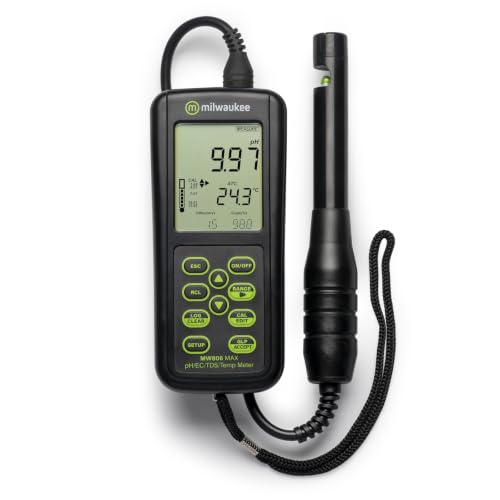
- Measures pH, EC, TDS, temperature, and mV
- USB export with logging and GLP data access
- High EC/TDS ranges with probe diagnostics
Best For: Portable high-range water testing with exportable records
Best Benchtop Option
Apera PH700 pH/Temperature Meter
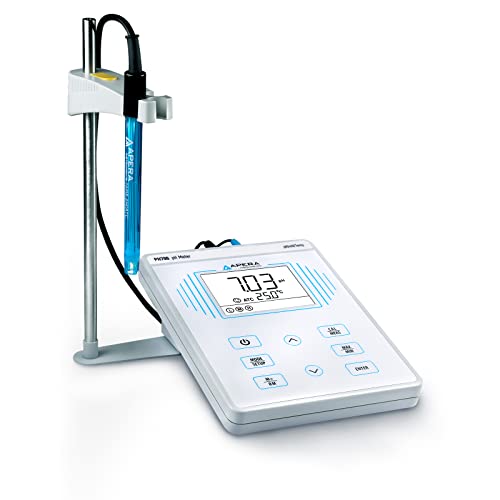
- 0.01 pH accuracy with 3-in-1 electrode
- One- to three-point automatic calibration
- Stores 50 data sets with electrode diagnostics
Best For: Benchtop pH and temperature testing
Best Connected Logger
Apera PC60-Z Bluetooth Smart Meter
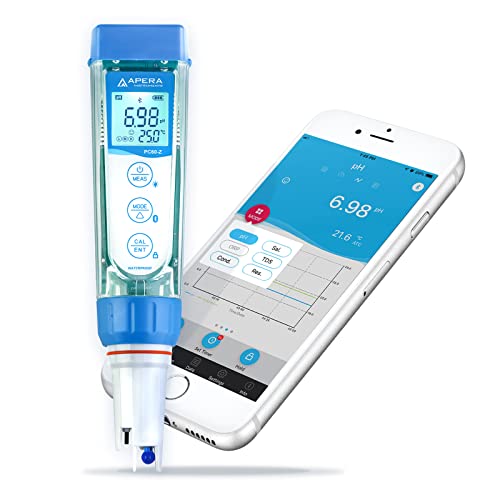
- Bluetooth control through the ZenTest mobile app
- Cloud-based logging for access and sharing
- Measures pH, conductivity, TDS, salinity, and resistivity
Best For: Connected multi-parameter testing with cloud records
Best Benchtop Data Logger

- Stores up to 1,000 records on the meter
- ±0.03 pH accuracy with 0.01 resolution
- Multiple modes, alerts, and BNC compatibility
Best For: Labs and QC teams needing high-capacity on-device logging
Best Portable Data Logger

- Stores and recalls 100 data sets
- Includes lead-free ATC electrode and carrying case
- Supports pH, mV, temperature, and automatic calibration
Best For: Field users who need portable measurements and basic logging
Best USB Data Management
Apera AI521 PH800 Benchtop Meter

- Stores 500 groups with USB data output
- Provides 0.01 pH accuracy and auto calibration
- Shows electrode slope and simultaneous pH/temperature
Best For: Research and QC workflows requiring USB-enabled records
Best SD-Card Logger – Sper Scientific 850060 pH Meter
If you need pH meters with data logging for water-testing work, the Sper Scientific 850060 emphasizes straightforward SD-card storage. It records pH, temperature, and ORP, then transfers formatted readings to Excel without extra software or cables.
Best For: Users who want portable pH, temperature, and ORP logging with convenient Excel transfer.
Pros:
- Stores pH, temperature, and ORP data on standard SD cards.
- Uploads pre-formatted data to Excel directly from the card.
- Offers automatic calibration recognition and automatic temperature compensation.
- Includes a backlit LCD, carrying case, batteries, and SD card.
Cons:
- The supplied notes do not specify a waterproof or ruggedized rating.
- Its SD-card workflow may be more equipment than needed for occasional spot checks.
Choose this model when transferable records and expandable SD-card storage matter more than a compact pen-style design.
Best Multiparameter Portable Kit – Apera PC8500 pH/Conductivity Meter
Apera Instruments Premium Series PC8500 Portable Handheld pH/Conductivity Meter Kit (AI5524)
Check Price On AmazonThe Apera PC8500 is a strong choice among pH meters with data logging when one handheld instrument must cover more than pH. It measures pH/mV and conductivity, TDS, and salinity, while storing up to 1,000 data sets with USB output.
Best For: Field and benchtop users who need logged pH and conductivity-related measurements in one kit.
Pros:
- Measures pH/mV plus conductivity, TDS, and salinity.
- Supports automatic or manual logging with 1,000 sets of storage.
- Provides USB data output and GLP data management.
- Includes automatic multipoint calibration, slope display, and calibration reminders.
Cons:
- Its broader multiparameter capability may be unnecessary for pH-only testing.
- Internal storage is limited to 1,000 data sets rather than unlimited card storage.
Pick the PC8500 if versatility, calibration guidance, and a rugged IP57 structure are priorities for field or benchtop work.
Best High-Capacity Logger – Extech SDL100 pH/ORP Meter
For buyers comparing pH meters with data logging, the Extech SDL100 stands out for high-capacity SD-card recording and flexible sampling intervals. It measures pH or ORP alongside temperature, with readings saved in Excel format for PC transfer.
Best For: Extended monitoring projects that benefit from scheduled sampling and large SD-card capacity.
Pros:
- Stores up to 20 million readings through a 2G SD card, according to the supplied notes.
- Offers sampling intervals from 5 to 600 seconds.
- Uses date- and time-stamped Excel-format records for PC transfer.
- Provides three-point calibration and a backlit dual LCD.
Cons:
- Manual onboard storage is limited to 99 readings.
- The product requires six batteries, as listed in the supplied specifications.
- The notes mention an additional CO2/humidity/temperature datalogger function without detailing its measurement setup.
The SDL100 is suited to repeated or long-duration logging where configurable intervals and SD-card capacity are more important than minimal size.
Best Research-Grade Benchtop – Apera PC9500 Multiparameter Meter
The Apera PC9500 is designed for lab workflows that need pH meters with data logging plus structured GLP records and data output. Its benchtop system measures pH/mV and conductivity-related parameters simultaneously, stores 1,000 sets, and supports USB export to a printer or PC.
Best For: Research and laboratory users who need guided calibration, organized records, and multiparameter benchtop testing.
Pros:
- Provides manual or automatic logging with 1,000 sets of storage.
- Exports data by USB to a pin-type mini printer or PC.
- Measures pH/mV or ORP alongside conductivity, TDS, salinity, and resistivity.
- Includes a TestBench with electrode holder, buffer organizers, and magnetic stirrer.
Cons:
- Its 7.83-pound benchtop format is less suited to portable testing.
- It may be excessive for users who only need basic pH readings.
- Internal logged storage is limited to 1,000 sets.
Choose the PC9500 when repeatability, GLP-oriented recordkeeping, and a complete benchtop setup justify a larger laboratory instrument.
Best High-Range Logger – Milwaukee MW806 Portable pH/EC/TDS Meter
Milwaukee Waterproof High Range Logging Portable pH/EC/TDS/mV/Temperature Meter with USB - MW806
Check Price On AmazonThe Milwaukee MW806 is a strong choice among pH meters with data logging when you need one portable instrument for pH, EC, TDS, temperature, and mV measurements. Its USB export, GLP data access, and probe diagnostics support more organized testing and troubleshooting.
Best For: Portable water testing that requires high EC/TDS ranges and exportable records.
Pros:
- Measures pH, EC, TDS, temperature, and mV with an amplified probe.
- Offers logging, USB data export, and one-button GLP data access.
- High measurement ranges include EC up to 20.00 mS/cm and TDS up to 16.00 g/L using the 0.8 conversion factor.
- Probe diagnostics can alert you to potential accuracy problems.
Cons:
- Its broader feature set may be more than needed for basic pH-only testing.
- The supplied notes do not specify storage capacity or battery details.
Choose the MW806 if high-range conductivity and TDS measurements matter as much as pH, and you want a portable meter that can move logged results to a computer through USB.
Best Benchtop Option – Apera PH700 pH/Temperature Meter
The Apera PH700 is a benchtop alternative for buyers who primarily need accurate pH and temperature measurements with straightforward data storage. It provides 0.01 pH accuracy, automatic calibration, electrode condition monitoring, and storage for 50 data sets.
Best For: Benchtop lab work focused on pH and temperature rather than multi-parameter field testing.
Pros:
- Provides 0.01 pH accuracy with a 3-in-1 pH/temperature electrode.
- Supports one- to three-point automatic calibration with self-diagnosis.
- Stores up to 50 sets of data and includes a maximum/minimum reading mode.
- Includes an electrode holder and premixed pH 4, 7, and 10 calibration solutions.
Cons:
- Data storage is limited to 50 sets and the supplied notes do not mention USB or cloud export.
- It is designed for benchtop use rather than highly portable testing.
- It measures pH and temperature, not EC, TDS, salinity, or resistivity.
The PH700 makes sense when reliable benchtop pH measurement and basic internal storage are the priority. Its included calibration materials also make setup more convenient for routine water-solution testing.
Best Connected Logger – Apera PC60-Z Bluetooth Smart Meter
The Apera PC60-Z stands out among pH meters with data logging for its Bluetooth connection and cloud-based ZenTest app workflow. It measures pH, conductivity, TDS, salinity, and resistivity, while allowing real-time control, calibration, and data management from a compatible smart device.
Best For: Professionals who want connected, shareable records for multi-parameter testing in the lab or field.
Pros:
- Connects to smartphones, tablets, or MacBooks through Bluetooth within a stated 30-foot range.
- Cloud-based logging helps manage, access, and share test data.
- Measures pH, conductivity, TDS, salinity, and resistivity with a double-junction combo sensor.
- Can operate as a standalone tester when not connected to a smart device.
Cons:
- Advanced app and cloud features require a compatible smart device and Bluetooth connection.
- The supplied notes do not specify the meter’s internal storage capacity or battery type.
- Probe warranty coverage is listed as six months, shorter than the instrument’s two-year warranty.
The PC60-Z is the best fit here for data-first workflows. Its combination of standalone operation, broad parameter coverage, and cloud logging is particularly useful when test records need to be accessed or shared across devices.
Best Benchtop Data Logger – LOHAND LH-T710 Lab pH Meter
For laboratories and facilities that need pH meters with data logging, the LOHAND LH-T710 combines precise benchtop testing with storage for up to 1,000 measurement records. Its broad measurement range, automatic calibration support, and multiple measurement modes make it suitable for repeatable testing and documentation.
Best For: Laboratory research, wastewater monitoring, water-quality inspection, and QC documentation where substantial on-device record storage is useful.
Pros:
- Stores up to 1,000 measurement records and allows records to be reviewed, queried, or deleted on the display.
- Offers ±0.03 pH accuracy, 0.01 pH resolution, and a -2 to 16 pH range.
- Supports multipoint automatic calibration, automatic or manual temperature compensation, and continuous, balanced, or interval measurement.
- Includes calibration reminders, high/low pH alarms, electrode slope display, and IP54 protection.
Cons:
- Its benchtop design is less convenient for field testing than a portable meter.
- The supplied notes describe on-device storage but do not mention USB or computer data export.
- At 3.71 pounds, it is better suited to a fixed workspace than frequent transport.
The LH-T710 is a strong choice when data capacity and on-screen record management matter more than portability. Standard BNC and temperature connections also make future electrode replacement more flexible.
Best Portable Data Logger – Apera SX711 Handheld pH Meter
The Apera SX711 is a practical option among pH meters with data logging for users who need lab-grade readings away from the bench. This handheld kit includes a lead-free ATC electrode, automatic calibration, and storage for 100 data sets in a rugged carrying case.
Best For: Field testing and portable lab work requiring pH, mV, and temperature measurements with basic data recall.
Pros:
- Provides 0.01 pH measurement capability with automatic temperature compensation.
- Stores and recalls 100 data sets for convenient test documentation.
- Includes automatic calibration, self-diagnosis, auto power-off, and ready-to-use pH buffers.
- Comes with a quality lead-free ATC pH probe and rugged carrying case.
Cons:
- Its 100-set storage capacity is considerably lower than the 1,000-record capacity of some benchtop alternatives.
- Portable operation and the included case may be less suited to high-volume, fixed-station record management.
- The supplied notes do not specify USB or computer export.
The SX711 balances portability and useful logging features without requiring a separate probe purchase. Choose it when measurements happen across multiple locations and 100 stored records are sufficient.
Best USB Data Management – Apera AI521 PH800 Benchtop Meter
For users comparing pH meters with data logging and external recordkeeping, the Apera AI521 PH800 stands out with GLP data management, 500 groups of storage, and USB data output. Its benchtop format is designed for stable measurements in research and quality-control settings.
Best For: Scientific research and QC workflows that need stored readings plus USB output for data management.
Pros:
- Stores 500 groups of data and provides USB data output.
- Offers 0.01 pH accuracy with one- to three-point automatic calibration.
- Uses a 201T-F pH/temperature combination electrode for regular water-solution testing.
- Displays electrode slope between calibrations and shows pH and temperature simultaneously on the backlit LCD.
Cons:
- Its 5.5-pound benchtop form is less portable than a handheld meter.
- The storage capacity is lower than the 1,000-record capacity offered by some competing benchtop models.
- The supplied notes focus on regular water solutions rather than specialized sample types.
The AI521 is a well-rounded choice when USB output and GLP-oriented data handling are more important than maximum storage capacity. Its slope display also helps users monitor electrode condition between calibrations.
How We Picked the Best Ph Meters with Data Logging
We focused on meters that can record measurements internally or transfer them to a computer, mobile device, USB drive, or SD card. The selection includes portable, benchtop, and multiparameter models so you can compare tools for field sampling, routine laboratory work, water treatment, hydroponics, aquariums, and research.
We also considered measurement capabilities, calibration support, automatic temperature compensation, electrode compatibility, display usability, power options, and data-management features. A meter with extensive logging is not automatically the best choice if its probe, interface, or operating format does not suit your workflow.
Quick Comparison
- Best for SD-card logging: Choose a model such as the Sper Scientific or Extech option when removable storage and straightforward file transfer matter.
- Best for multiparameter testing: Apera PC8500, PC9500, PC60-Z, and Milwaukee MW806 models add measurements such as conductivity, TDS, salinity, resistivity, ORP, or temperature.
- Best for laboratory documentation: Benchtop Apera models provide more controlled setups, BNC electrode connections, and stronger GLP-oriented data handling.
- Best for portable pH-only work: A compact handheld meter with a data logger is easier to carry between sampling locations than a benchtop instrument.
Key Buying Factors for Ph Meters with Data Logging
Logging and Export Format
Check whether records are saved to SD card, USB, internal memory, or a phone app. Confirm the supported file format, timestamp functions, sampling interval, memory capacity, and whether calibration or operator information is included. GLP features are especially useful when results must be traceable.
Measurement Range and Resolution
Most general-purpose instruments cover the standard pH range, but resolution and stated accuracy vary. For routine testing, 0.01 pH resolution is commonly sufficient. Research, quality-control, or regulated work may require better documentation and a meter designed for stricter procedures.
Probe, Temperature, and Calibration Support
Automatic temperature compensation helps produce more consistent readings, but it does not replace proper calibration. Look for one-, two-, or three-point calibration, suitable buffer recognition, replaceable electrodes, and a temperature sensor. Verify that replacement probes are available before buying.
Portability and Durability
Portable models are preferable for tanks, waterways, production areas, and greenhouse work. Waterproof construction, a protective case, long battery life, and a readable display can matter more than advanced laboratory features in the field.
Who Should Buy Which Ph Meters with Data Logging?
Choose a portable SD-card logger for recurring field measurements where you need simple, transferable records without relying on a phone or laptop. Choose a Bluetooth model if app-based viewing, guided testing, and quick sharing are more valuable than removable storage.
Choose a multiparameter meter when pH is only one part of your testing routine and you also need conductivity, TDS, salinity, resistivity, ORP, or temperature. Choose a benchtop system for laboratories and quality-control stations that prioritize stable placement, BNC electrode flexibility, calibration records, and GLP-style documentation.
Before ordering, confirm the included electrode, required accessories, logging method, and compatibility with your existing calibration and reporting process. Those details often determine whether a meter is genuinely convenient after purchase.