Portable water quality meters make it easier to check drinking water, aquariums, pools, hydroponic systems, and field samples without relying on a laboratory for every reading.
This roundup compares ten options, from simple TDS pens to multiparameter testers that measure pH, conductivity, salinity, turbidity, temperature, and related indicators.
Best 10 Portable Water Quality Meters Picks for 2026
Best All-Around Pick
Apera PC60 5-in-1 Pocket Tester

- Measures pH, EC, TDS, salinity, and temperature
- Replaceable probe and clear backlit display
- Includes calibration supplies and carrying case
Best For: Multi-parameter home and field testing
Best for Turbidity Testing
Sper Scientific Portable Turbidity Meter

- Uses nephelometric turbidity measurement
- Automatic two-point calibration and autoranging
- Includes standards, bottles, and carry case
Best For: Dedicated turbidity testing in field or lab settings
Best Budget TDS Meter

- Measures TDS from 0 to 10,000 ppm
- Automatic calibration and temperature compensation
- Compact kit with calibration supplies and case
Best For: Straightforward dissolved-solids testing
Best for App-Based Tracking
Kactoily 6-in-1 Smart Water Tester

- Tests six parameters including TDS, EC, TOC, and COD
- Records results through a companion app
- Color-coded display and compact pen-style design
Best For: Home monitoring across multiple water sources
Most Versatile Pick
7-in-1 Bluetooth Water Quality Meter

- Tests pH, TDS, salinity, EC, ORP, specific gravity, and temperature
- Bluetooth connectivity supports saving and sharing readings
- Compact design suits pools, aquariums, RO systems, and hydroponics
Best For: Users who need multiple water measurements in one portable tester
Best Everyday TDS Tester
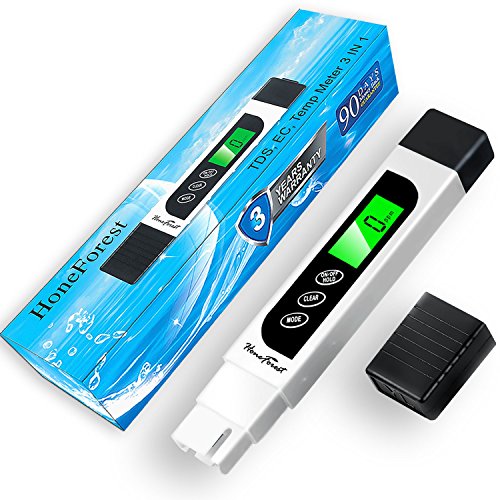
- Measures TDS, EC, and temperature
- Backlit LCD and auto-lock simplify reading results
- Suitable for drinking water, RO/DI systems, aquariums, and hydroponics
Best For: Routine dissolved-solids and conductivity checks
Best Simple TDS Meter
HM Digital TDS-EZ Water Tester

- Measures TDS across a 0–9,990 ppm range
- Large LCD, hold function, and automatic shutoff
- Includes batteries and supports recalibration
Best For: Straightforward household TDS monitoring
Most Comprehensive
Landtek 9-in-1 Water Quality Tester

- Measures nine key water parameters
- Color-coded four-level quality display
- Compact, temperature-compensated design
Best For: Broad household and outdoor water analysis
Best for Routine TDS Checks
MEXYBE 4-in-1 Digital Water Tester

- Measures TDS, EC, and temperature
- Large backlit LCD with hold function
- Useful for RO/DI, aquariums, and pools
Best For: Simple everyday dissolved-solids monitoring
Best Lightweight Option
DANOPLUS 6-in-1 Water Quality Tester

- Six-parameter water-quality testing
- Color-coded results are easy to interpret
- Lightweight for travel and outdoor use
Best For: Portable screening during camping, hiking, and travel
Best All-Around Pick – Apera PC60 5-in-1 Pocket Tester
The Apera PC60 is a versatile choice among portable water quality meters, combining pH, conductivity, TDS, salinity, and temperature testing in one pocket-sized device. Its replaceable probe, dual-display screen, calibration reminders, and included carrying case make it practical for repeat testing in the field or at home.
Best For: Users who need several common water measurements in one portable tester.
Pros:
- Measures five parameters: pH, EC, TDS, salinity, and temperature.
- Replaceable multi-parameter probe simplifies long-term maintenance.
- Large backlit LCD shows temperature alongside the selected measurement.
- Includes calibration solutions, storage solution, batteries, and carrying case.
Cons:
- The broader feature set may be unnecessary for users who only need TDS or pH.
- The electrode has a shorter warranty period than the instrument.
Choose the PC60 when flexibility matters more than having a single-purpose meter. Its complete kit and clear stability indicators help make routine measurements more convenient.
Best for Turbidity Testing – Sper Scientific Portable Turbidity Meter
For buyers focused specifically on suspended-particle measurement, this Sper Scientific model is one of the more specialized portable water quality meters. It uses the nephelometric method, meets ISO 7027 standards, and adds automatic calibration, autoranging, and min/max recall for field or laboratory work.
Best For: Water-treatment, environmental, industrial, and laboratory users measuring turbidity.
Pros:
- Measures turbidity using a method described as meeting ISO 7027 standards.
- Automatic two-point calibration can be completed with push-button controls.
- Bright LCD, autoranging, and min/max recall support practical testing.
- Includes calibration solutions, sample bottles, distilled water, and cleaning cloth.
Cons:
- It measures turbidity rather than multiple parameters such as pH or TDS.
- At 4 pounds, it is substantially heavier than pocket-style testers.
- Requires six AAA batteries.
This is the strongest fit when turbidity is the primary measurement and a more complete field kit is useful. It is less suitable for buyers seeking a lightweight, general-purpose pocket tester.
Best Budget TDS Meter – Apera TDS20 Pocket Tester
The Apera TDS20 is a focused option for shoppers comparing portable water quality meters for dissolved-solids testing. It measures from 0 to 10,000 ppm, includes automatic temperature compensation, and comes as a compact kit with calibration supplies and a carrying case.
Best For: Users who primarily need TDS readings and want a simple pocket tester.
Pros:
- Offers a 0–10,000 ppm range with stated accuracy of ±1% full scale.
- Automatic calibration includes buffer recognition.
- Automatic temperature compensation operates from 0 to 50°C.
- Includes calibration solutions, batteries, lanyard, and portable case.
Cons:
- It is designed for TDS testing rather than broad multi-parameter analysis.
- It does not provide the pH, salinity, or turbidity measurements offered by other options here.
The TDS20 makes sense when a dedicated dissolved-solids meter is all you need. Its compact size, long stated battery operation, and included accessories keep routine testing straightforward.
Best for App-Based Tracking – Kactoily 6-in-1 Smart Water Tester
The Kactoily 6-in-1 stands out among portable water quality meters by combining TDS, EC, TOC, COD, UV275, and temperature readings with app-based record keeping. Its color-coded display and compact pen-style design are aimed at users who want quick comparisons across tap water, wells, RV systems, or other sources.
Best For: Home users who want multiple readings, visual status levels, and saved test history.
Pros:
- Measures six parameters, including TDS, EC, TOC, COD, UV275, and temperature.
- App connectivity supports manual result saving and longer-term trend tracking.
- Four color levels provide quick visual interpretation of stabilized readings.
- Compact pen-style design suits home, camping, RV, lake, and pond testing.
Cons:
- App use adds a setup and connectivity step compared with standalone meters.
- The supplied notes do not specify numeric accuracy or measurement ranges.
- Calibration is limited to a one-button process using purified or distilled water.
This model is appealing when tracking and broad screening matter more than conventional single-parameter testing. Buyers who require documented accuracy specifications should review those details before choosing it.
Most Versatile Pick – 7-in-1 Bluetooth Water Quality Meter
For shoppers comparing portable water quality meters, this 7-in-1 model stands out for combining pH, TDS, salinity, EC, ORP, specific gravity, and temperature testing in one compact device. Bluetooth data transmission also supports saving, managing, and sharing readings through the app.
Best For: Pool owners, aquarium keepers, hydroponics users, and anyone who needs several water measurements from one portable tester.
Pros:
- Measures seven water parameters with one-key switching.
- Supports Bluetooth data transmission for organizing and sharing readings.
- Compact, lightweight design is convenient for on-the-go testing.
- Suitable for pools, aquariums, drinking water, RO systems, spas, and hydroponics.
Cons:
- Its broader feature set may be more than needed for simple TDS testing.
- The supplied details do not specify battery type or runtime.
This is the most feature-rich option in the group. Choose it if you want pH and ORP testing alongside conductivity, dissolved-solids, salinity, specific-gravity, and temperature readings.
Best Everyday TDS Tester – Backlit 3-in-1 TDS Meter
This 3-in-1 option is one of the most practical portable water quality meters for routine checks. It measures TDS, electrical conductivity, and temperature, with a backlit LCD, auto-lock readings, and an automatic shutoff for straightforward use.
Best For: Drinking-water checks, RO/DI system monitoring, aquarium maintenance, hydroponics, and pool or spa testing.
Pros:
- Measures TDS, EC, and temperature in one device.
- Reads up to 9,990 ppm and offers an easy-to-read backlit display.
- Automatically stabilizes and locks readings within seconds.
- Includes a portable leather bag for storage and transport.
Cons:
- It does not measure pH, ORP, or salinity.
- Its plastic construction may feel less substantial than heavier instruments.
With its simple operation and focused measurement set, this is a strong choice for users who primarily want to check dissolved solids, conductivity, and temperature without paying for extra functions.
Best Simple TDS Meter – HM Digital TDS-EZ Water Tester
For buyers who want a straightforward option among portable water quality meters, the HM Digital TDS-EZ focuses on TDS readings without adding unnecessary functions. It covers 0–9,990 ppm, displays readings on a large LCD, and includes hold and automatic shutoff features.
Best For: End users checking drinking water, filters, and general TDS levels who prefer a simple dedicated meter.
Pros:
- Measures TDS from 0 to 9,990 ppm.
- Large LCD and hold function make readings easy to view and record.
- Battery life is approximately 1,000 hours, with batteries included.
- Can be recalibrated with a mini-screwdriver.
Cons:
- Measures TDS only; it does not test temperature, EC, or pH.
- Resolution changes from 1 ppm to 10 ppm above 999 ppm.
- It lacks the broader testing range of multi-function meters.
This dedicated meter is a sensible pick for uncomplicated TDS monitoring. Its hold function, long stated battery life, and recalibration capability add convenience for regular household use.
Most Comprehensive – Landtek 9-in-1 Water Quality Tester
For shoppers seeking portable water quality meters with broad coverage, this Landtek model measures nine parameters, including TDS, EC, salinity, hardness, specific gravity, temperature, COD, TOC, and UV275. Its color-coded display and compact design make it practical for household and on-the-go testing.
Best For: Home users who want multi-parameter testing for tap, purified, well, surface, seawater, or aquaculture water.
Pros:
- Measures nine water-quality parameters in one device.
- Color-coded backlight provides four simple quality ratings.
- Built-in temperature compensation supports measurements from 0–50°C.
- Calibration uses distilled or pure water without calibration powder.
Cons:
- Its broader feature set may be more than needed for basic TDS checks.
- Experimental use requires weekly calibration.
This is the strongest choice when you want more than dissolved-solids readings. The nine-parameter design offers the broadest testing scope here, while the color display keeps everyday interpretation straightforward.
Best for Routine TDS Checks – MEXYBE 4-in-1 Digital Water Tester
This MEXYBE is one of the more straightforward portable water quality meters for checking TDS, EC, and temperature. Its large backlit display, hold function, auto-lock, and 0–9999 ppm range make it convenient for routine drinking-water, RO/DI, aquarium, and pool monitoring.
Best For: Users who primarily need an easy-to-read TDS and conductivity meter for home water systems or aquarium maintenance.
Pros:
- Provides TDS, EC, Celsius, and Fahrenheit readings.
- Large backlit LCD is designed for easier viewing.
- Factory calibration and hold function support quick use.
- Auto-off after two minutes helps conserve battery power.
Cons:
- Measures fewer parameters than the 6-in-1 and 9-in-1 options.
- Its readings indicate dissolved solids and conductivity, not a complete water-safety analysis.
Choose this model if your main goal is monitoring TDS, filters, RO/DI performance, or aquarium water. The simple interface and large display favor frequent, uncomplicated checks.
Best Lightweight Option – DANOPLUS 6-in-1 Water Quality Tester
The DANOPLUS combines six measurements—TOC, COD, EC, UV275, temperature, and TDS—in a lightweight portable body. Among portable water quality meters, it stands out for pairing broader testing than a basic TDS pen with a color-coded rating display for home, travel, camping, and emergency use.
Best For: Travelers, campers, RV users, and households wanting a lightweight tester with expanded water-quality indicators.
Pros:
- Measures six parameters, including TOC, COD, UV275, EC, temperature, and TDS.
- Four-color display helps simplify result interpretation.
- Compact design and included AAA batteries suit travel and outdoor use.
- Three-second calibration uses distilled or pure water.
Cons:
- It does not measure salinity, hardness, or specific gravity.
- Experimental applications call for weekly calibration.
With a listed weight of just 2.4 ounces, this is a practical middle ground between a basic TDS meter and a more feature-heavy analyzer. It is especially appealing when packability and broader screening both matter.
How We Picked the Best Portable Water Quality Meters
We focused on measurement range, stated accuracy, calibration options, probe design, portability, display readability, and practical use cases. The selection includes dedicated TDS testers, multiparameter meters, turbidity instruments, and app-connected devices so different buyers can choose an appropriate level of testing.
Because water meters vary widely in what they measure, we treated feature coverage and measurement consistency as more important than a long list of advertised modes. A reliable single-purpose meter can be a better choice than an inexpensive device with several poorly documented functions.
Quick Comparison
| Meter Type | Best For | Typical Measurements | What to Check |
|---|---|---|---|
| TDS pen | Fast routine checks | TDS, EC, temperature | Accuracy, calibration, range |
| Multiparameter tester | Detailed water monitoring | pH, EC, TDS, salinity, temperature, ORP | Probe quality and calibration support |
| Turbidity meter | Cloudiness and suspended particles | Turbidity | Calibration standards and sample handling |
| App-connected tester | Logging and trend tracking | Varies by model | App compatibility and data export |
Key Buying Factors for Portable Water Quality Meters
Measure the Parameter You Actually Need
TDS estimates dissolved solids through electrical conductivity, but it does not identify specific contaminants or prove that water is safe to drink. Choose pH measurement for acidity and alkalinity checks, turbidity measurement for suspended particles, and salinity measurement for aquariums or saltwater systems.
Check Accuracy, Resolution, and Calibration
Accuracy describes how close a reading may be to the true value, while resolution describes the smallest displayed change. Look for automatic or two-point calibration where appropriate, and confirm that calibration solutions are available. Regular calibration matters more than a highly precise display.
Consider Maintenance and Field Use
Waterproof construction, replaceable probes, automatic temperature compensation, a protective cap, and a clear backlit display can make a major difference outside the lab. Rinse the probe after use, avoid cross-contamination, and follow the manufacturer’s storage instructions.
Do Not Overinterpret TDS Readings
A low TDS reading does not automatically mean water is contaminant-free, and a high reading does not identify which substances are present. Use these meters for screening and routine monitoring; use certified laboratory testing when health, regulatory, or contamination concerns are involved.
Who Should Buy Which Portable Water Quality Meters?
Choose a basic TDS meter if you need quick comparisons for filtered water, reverse-osmosis systems, or routine household checks. Choose a multiparameter meter for aquariums, hydroponics, pools, laboratories, or users who need pH and conductivity data together. Choose a turbidity meter when water clarity and suspended particles are the primary concern. Choose an app-enabled model if saving readings, reviewing trends, or sharing records is important.
Before buying, match the meter’s specifications to your water source and testing routine. The best Portable Water Quality Meters are the ones that measure the right parameters, can be calibrated reliably, and are simple enough to use consistently.